Custom Duct Elbows, Made to Order in Any Size and Angle
Rectangular duct elbows fabricated to your exact width, depth, bend angle and throat radius in galvanized, aluminum or stainless, with or without turning vanes. Set the size below, watch it build in 3D, and see the price change as you type.
Looking for a specific size? See all 429 duct elbow sizes we publish, with prices. Each size has its own page you can order from, in galvanized, aluminum and stainless.
Elbow Radius Calculator
Enter the duct size and the centerline-radius-to-width ratio you want. We compute the centerline, throat and heel radii, the space the elbow takes up, and the velocity at your CFM. Then load it straight into the designer for a live price.
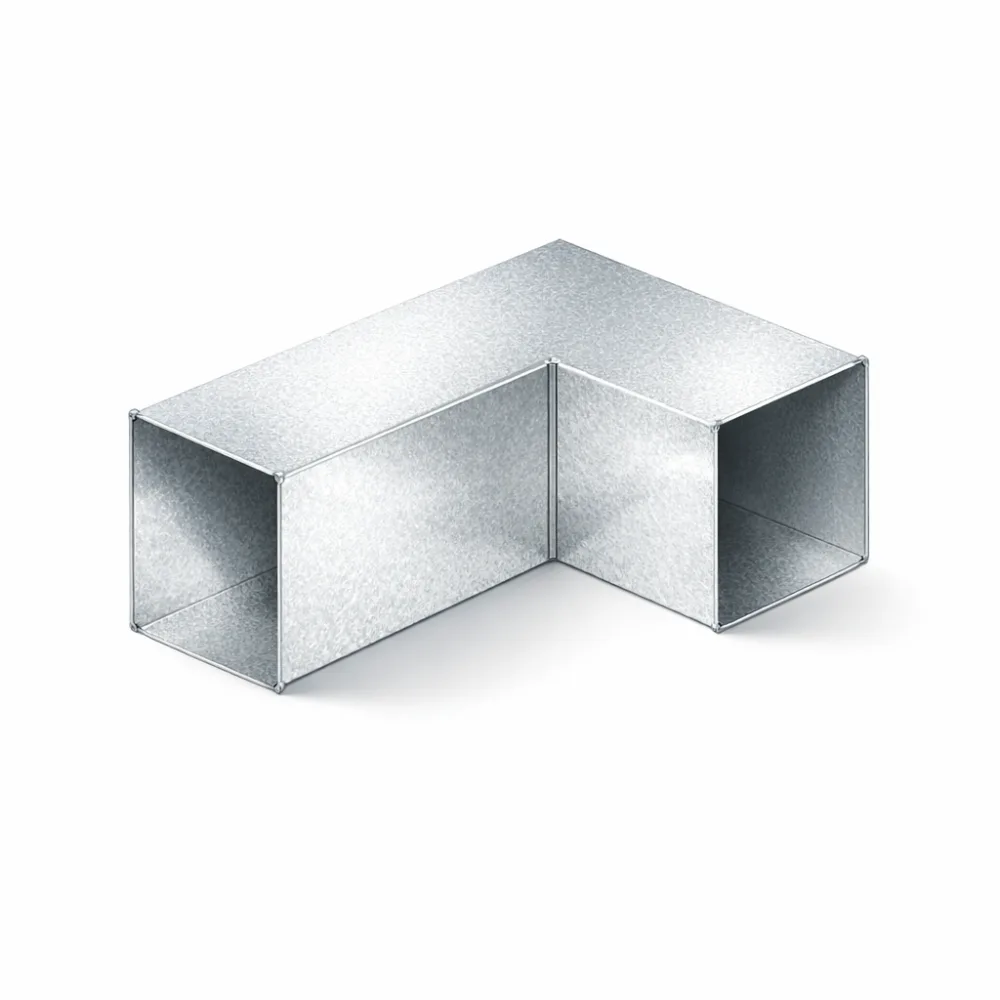
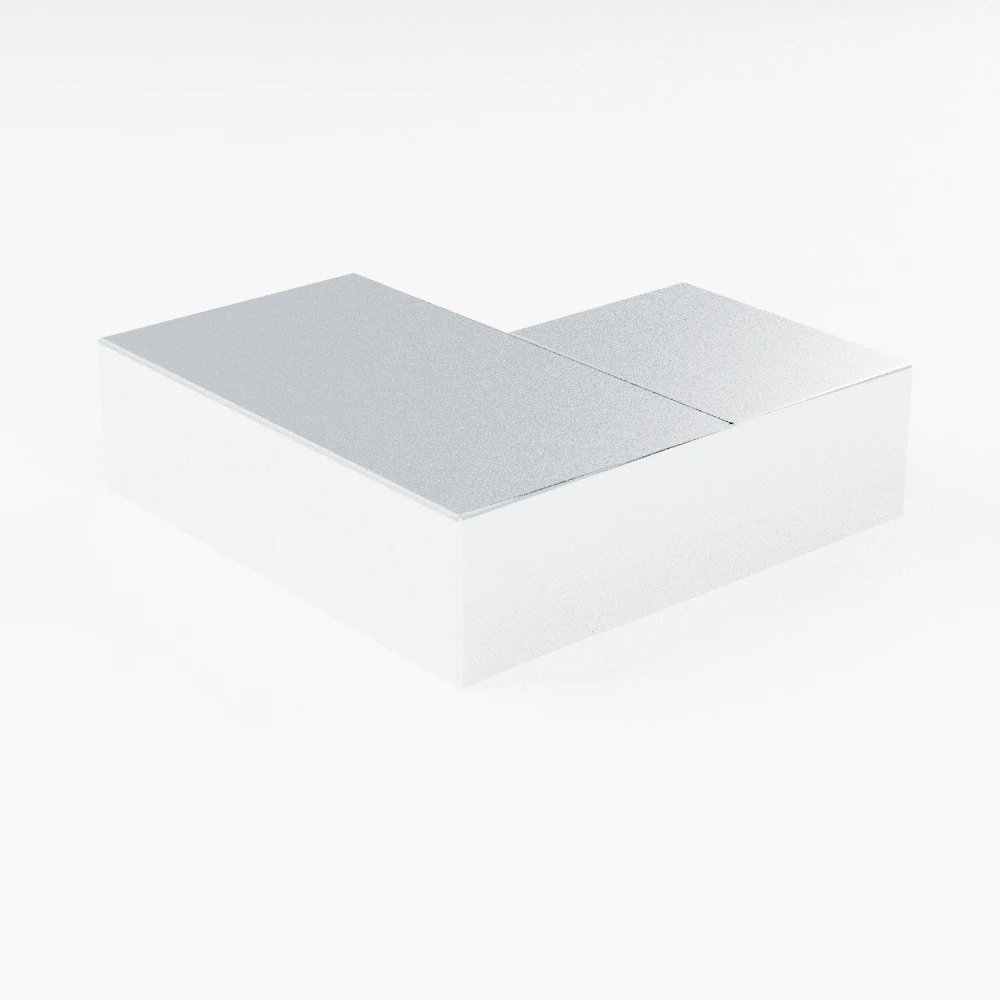
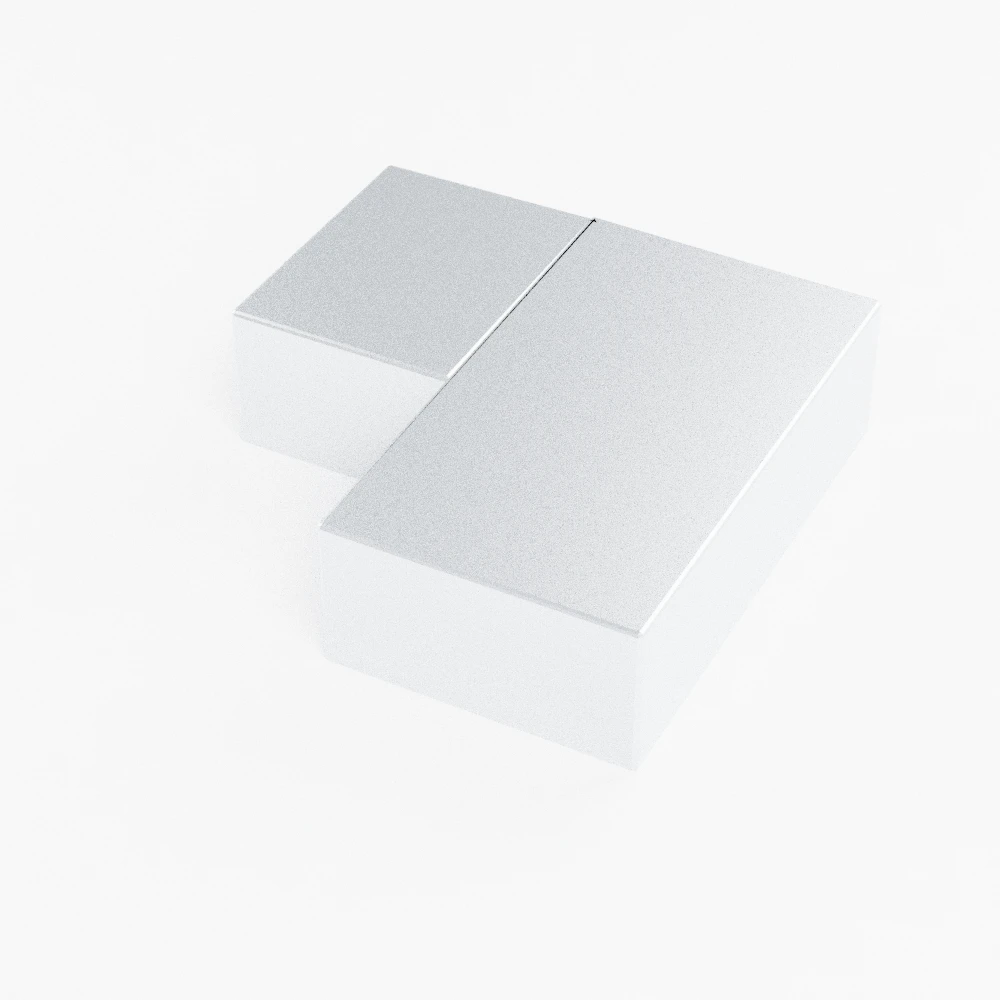
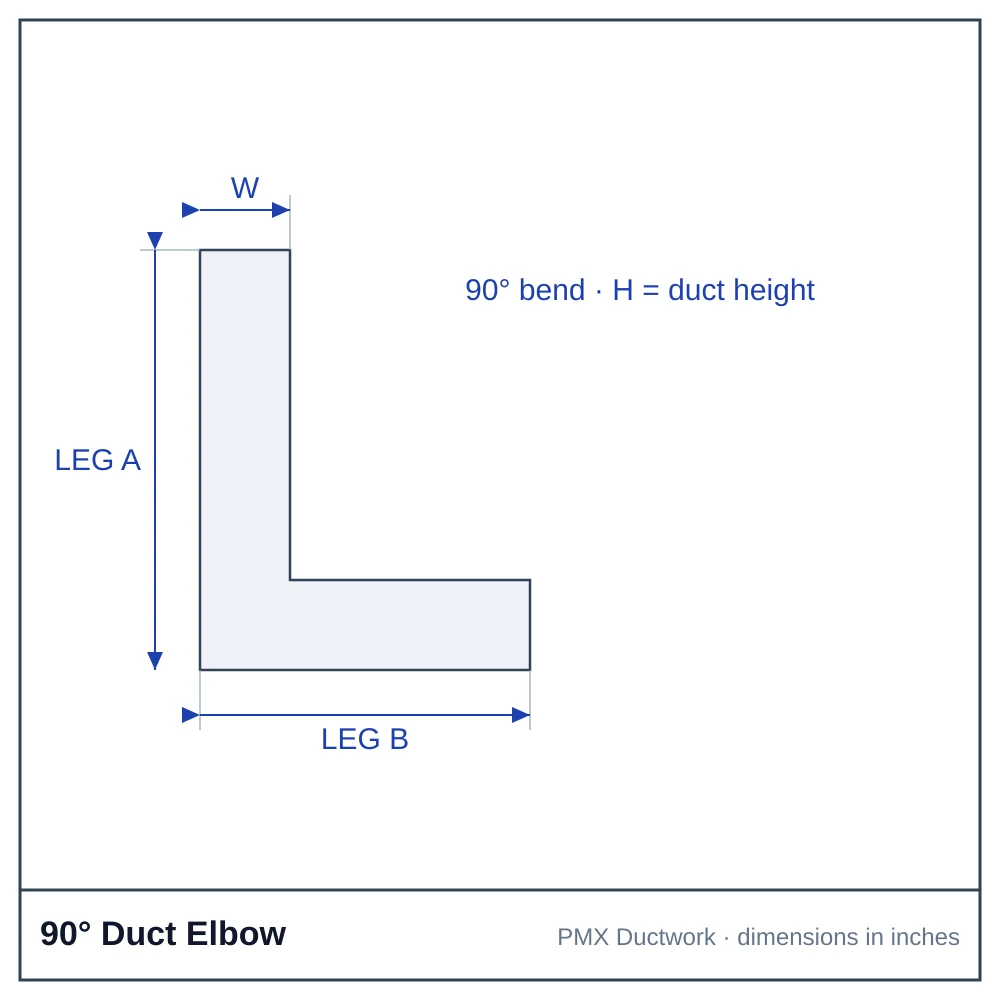
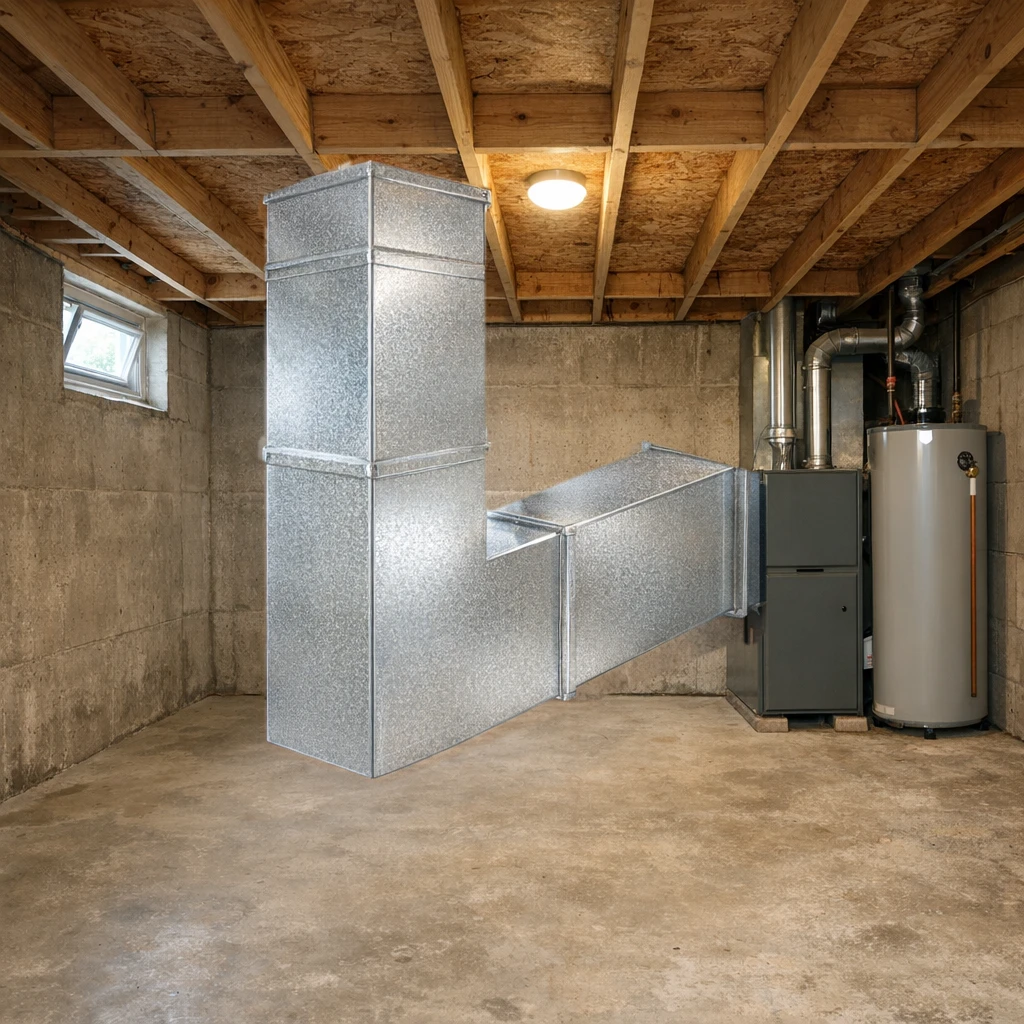
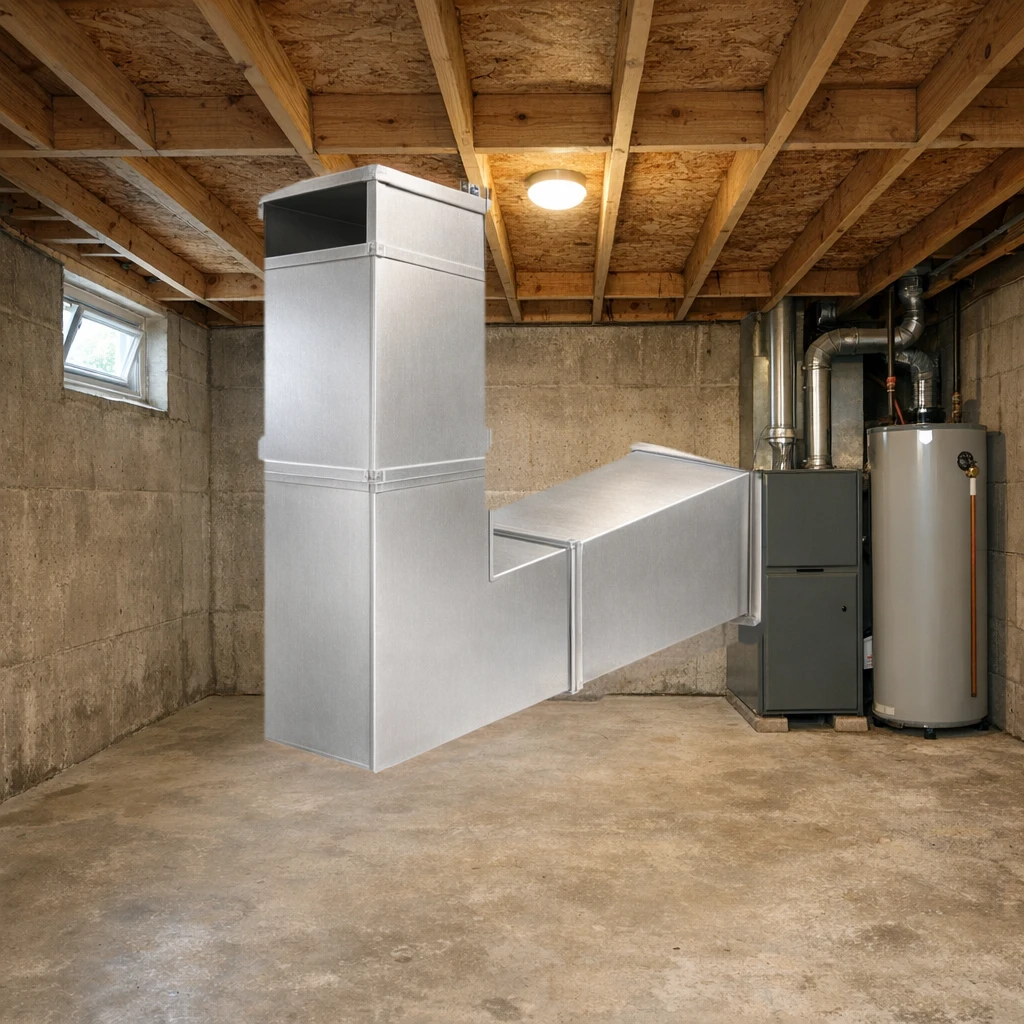
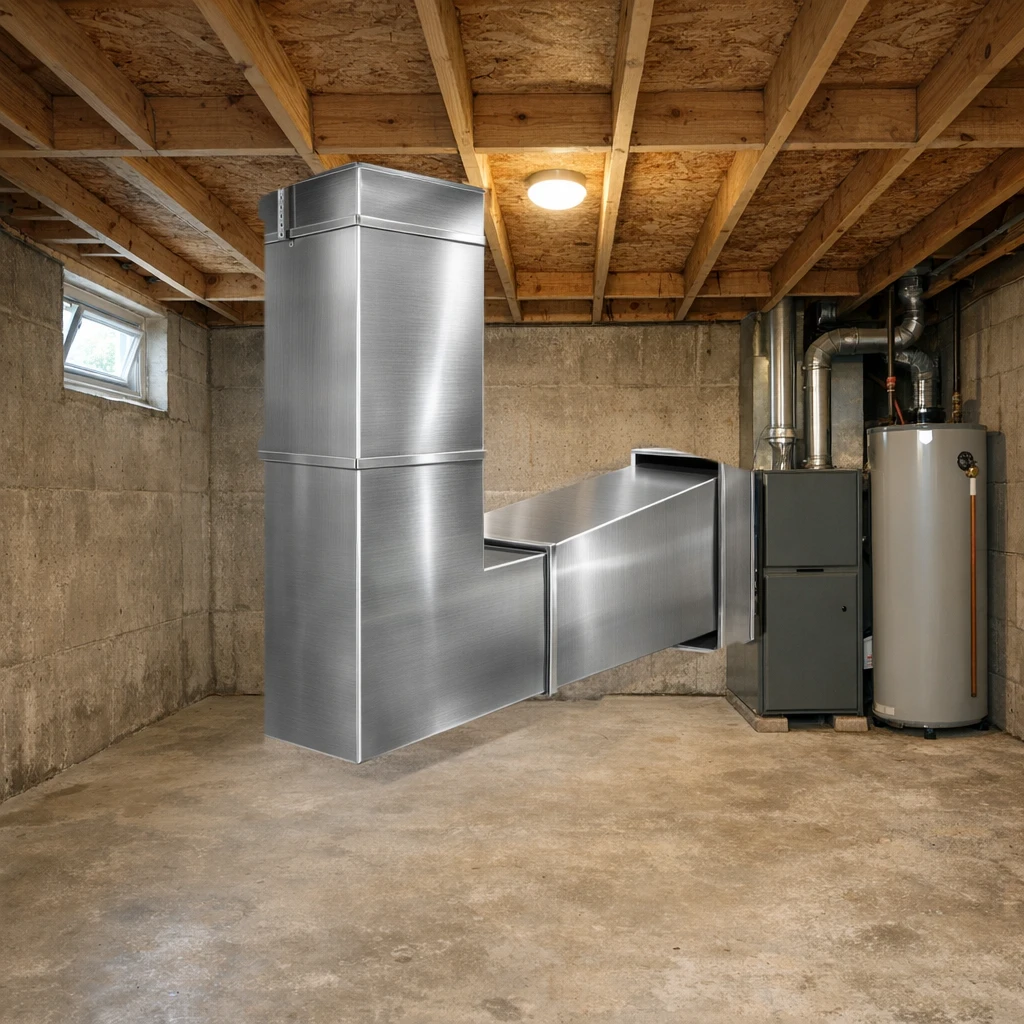
Specifications
- Inlet Width: 1" to 36"
- Outlet Width: 1" to 36" (independent of the inlet)
- Depth: 1" to 36"
- Throat Radius: 0" (square throat) to 60", set separately for each leg
- Bend Angle: 90°, 45°, 22.5°, 20°
- Turning Vanes: None or small vanes
- Materials: Galvanized Steel, Aluminum, Stainless Steel
- Gauges: 26, 24, 22, 20
- Connections: Raw, Slip-and-Drive, FoldOut, DoubleFoldOut, DuctMate Flange
Ships in 1 business day. Every fitting is cut, formed and inspected in our Pittsburgh shop and leaves the next business day — not the one to three weeks most custom shops quote.
Popular Duct Elbow Sizes & Prices
Square-throat 90 degree elbows, same width in and out, slip-and-drive both ends. Every row is its own orderable page; the full list of 429 sizes adds aluminum and stainless for each, and the designer above prices radius throats, other angles and turning vanes.
| Width x depth | Angle | Material | Gauge | Price | Order |
|---|---|---|---|---|---|
| 6" x 6" | 90° | Galvanized | 26 ga | $73.40 | Order this size |
| 8" x 6" | 90° | Galvanized | 26 ga | $76.52 | Order this size |
| 8" x 8" | 90° | Galvanized | 24 ga | $84.40 | Order this size |
| 10" x 6" | 90° | Galvanized | 24 ga | $84.19 | Order this size |
| 10" x 8" | 90° | Galvanized | 24 ga | $87.72 | Order this size |
| 10" x 10" | 90° | Galvanized | 24 ga | $91.26 | Order this size |
| 12" x 8" | 90° | Galvanized | 24 ga | $91.05 | Order this size |
| 12" x 10" | 90° | Galvanized | 24 ga | $94.80 | Order this size |
| 12" x 10" | 90° | Aluminum | 24 ga | $133.80 | Order this size |
| 12" x 10" | 90° | Stainless | 24 ga | $172.80 | Order this size |
| 12" x 12" | 90° | Galvanized | 24 ga | $98.54 | Order this size |
| 14" x 8" | 90° | Galvanized | 24 ga | $94.38 | Order this size |
| 14" x 10" | 90° | Galvanized | 24 ga | $98.33 | Order this size |
| 14" x 12" | 90° | Galvanized | 24 ga | $102.28 | Order this size |
| 16" x 10" | 90° | Galvanized | 24 ga | $101.87 | Order this size |
| 16" x 12" | 90° | Galvanized | 22 ga | $112.53 | Order this size |
| 16" x 12" | 90° | Aluminum | 22 ga | $161.28 | Order this size |
| 16" x 12" | 90° | Stainless | 22 ga | $210.03 | Order this size |
| 18" x 12" | 90° | Galvanized | 22 ga | $116.27 | Order this size |
| 20" x 12" | 90° | Galvanized | 22 ga | $120.02 | Order this size |
| 20" x 14" | 90° | Galvanized | 22 ga | $124.59 | Order this size |
| 24" x 12" | 90° | Galvanized | 22 ga | $127.50 | Order this size |
| 24" x 16" | 90° | Galvanized | 22 ga | $142.90 | Order this size |
| 30" x 16" | 90° | Galvanized | 20 ga | $175.56 | Order this size |
Custom Rectangular Duct Elbows: The Complete Guide
A duct elbow, also called an ell, a turn, a 90 or simply a bend, is the fitting that changes the direction of a rectangular duct run. It is the most common fitting on any job after straight duct, and it is also the fitting that supply houses stock in the fewest useful sizes. Stock elbows come in a handful of square sizes with a square throat; the moment a trunk is 20" x 8", 24" x 10" or 18" x 14", or the turn needs a radius throat, or the elbow has to reduce as it turns, or the bend is 45 degrees instead of 90, the stock shelf has nothing. That is why we build every elbow to the exact numbers you type in, and why this page exists.
Everything below is what we tell customers on the phone: what the fitting is, which dimension is the width and which is the depth, how to pick the throat radius, when turning vanes are worth it, which angle to use, which gauge and material to specify, how the ends connect, and how to measure the space you have. If you already know your numbers, the designer above prices them instantly and the popular-sizes table links to a page for each common size.
What a rectangular duct elbow actually is
A rectangular elbow is made of four pieces of sheet metal. Two flat cheeks are cut to the shape of the turn seen from the side: they carry the inlet edge, the outlet edge, the curve or corner of the throat and the curve or corner of the heel. Between the cheeks run two walls. The heel is the outside wall of the turn; the throat is the inside wall. On a square-throat elbow both walls are flat and meet the cheeks at a sharp corner; on a radius elbow the heel and throat are rolled to a curve and the cheeks are cut to match. The cheeks are joined to the walls with a Pittsburgh lock seam or a snap lock, and each leg ends in the connection you specify.
Our designer builds the elbow as two legs joined at a mitered seam whose plane bisects the bend angle, so both legs meet cleanly at 90, 45, 22.5 or 20 degrees. Each leg has its own throat radius, which is the leg's length measured from the seam, so you can give the inlet leg a long throat and the outlet leg a short one where the fitting has to tuck in behind something. Set both throats to zero and you have a square-throat elbow; set them equal to half the width and you have a centerline radius equal to the width, which is the standard low-loss rectangular elbow.
Width, depth, and which way the elbow turns
The single most common mistake on an elbow order is swapping the two cross-section dimensions. The rule is simple once you picture the fitting: the width is the dimension in the plane of the turn, from the heel wall to the throat wall. The depth is the dimension across the two flat cheeks, at right angles to the turn. A 20" x 8" basement trunk that turns while staying flat against the joists has a width of 8" and a depth of 20"; that elbow is called a flat elbow or an easy-way elbow, because the air turns across the short dimension and the fitting takes very little room. The same trunk turning on edge, so that the 20" dimension is in the plane of the turn, has a width of 20" and a depth of 8"; that is a hard-way elbow, and it needs a much bigger radius to turn well. Both are the same size of duct and completely different fittings. The 3D view in the designer updates as you type, so look at it before you add to cart.
Where rectangular elbows are used
- Trunk direction changes. The extended plenum trunk in a basement or attic turns at the end of the house, around a stair, or to follow a beam. These are usually flat elbows in the trunk size, 20" x 8" to 30" x 10", square or radius throat.
- Furnace and air-handler connections. The supply plenum turns 90 degrees to the trunk, or the return drop turns into the side of the furnace. These are hard-way elbows in the plenum size, and a radius throat with vanes matters here because the velocity is highest right at the equipment.
- Reducing turns. A trunk that steps down at the same place it turns: 24" wide in, 18" wide out, at the same depth. One reducing elbow replaces an elbow plus a transition and saves a joint and a foot of duct.
- 45 and 22.5 degree jogs. A pair of 45s with a short straight between them clears a beam or a pipe; two 22.5s bend a long run gently. When the jog is short and the offset is known, a one-piece offset fitting is usually the cleaner choice.
- Commercial and exhaust work. Larger elbows in 22 and 20 gauge with flanged ends, often stainless for kitchen grease exhaust or aluminum for corrosive exhaust, where the stock shelf never had the size in the first place.
Sizing the throat radius: the R/W ratio
The number that decides how well an elbow performs is the ratio of the centerline radius to the duct width in the plane of the turn, written R/W. The centerline radius is measured from the center of the bend to the middle of the duct; the throat radius is the centerline radius minus half the width, and the heel radius is the centerline radius plus half the width:
Rthroat = (R/W × W) − W ÷ 2 Rheel = (R/W × W) + W ÷ 2
An R/W of 0.5 puts the throat radius at zero: a square throat. An R/W of 1.0 makes the throat radius half the width and the heel radius one and a half times the width; that is the standard smooth rectangular elbow and the one most engineering guides assume. Larger ratios lower the loss further, with diminishing returns beyond about 1.5. Some reference values for common widths:
| Width in the plane of the turn | R/W = 0.75 throat / heel | R/W = 1.0 throat / heel | R/W = 1.5 throat / heel |
|---|---|---|---|
| 8" | 2" / 10" | 4" / 12" | 8" / 16" |
| 10" | 2.5" / 12.5" | 5" / 15" | 10" / 20" |
| 12" | 3" / 15" | 6" / 18" | 12" / 24" |
| 14" | 3.5" / 17.5" | 7" / 21" | 14" / 28" |
| 16" | 4" / 20" | 8" / 24" | 16" / 32" |
| 20" | 5" / 25" | 10" / 30" | 20" / 40" |
| 24" | 6" / 30" | 12" / 36" | 24" / 48" |
The practical consequence is space. At R/W = 1.0 a 24" wide hard-way elbow reaches 36" from the center of the bend to the back of the heel on each leg, which is why large trunks are almost always turned the easy way, with the short dimension in the plane of the turn. The calculator at the top of this page gives the reach of each leg for the size and ratio you choose, so you can check it against the joist bay or the chase before you order. A square-throat elbow with turning vanes is the answer when the reach of a radius elbow will not fit.
Turning vanes: when they are worth it
Turning vanes are a set of small curved blades mounted across the throat of the elbow that divide one sharp turn into many gentle ones. On a square-throat 90 degree elbow they cut the pressure loss by well over half, and they cut the noise that a square elbow makes at supply-trunk velocities. The rules we use: any square-throat 90 that carries real airflow gets vanes; any radius elbow with an R/W under about 0.75 benefits from them; a radius elbow at R/W of 1.0 or more does not need them, and adding them there only adds cost and a place for dust to collect. Vanes are not used on 45 degree and shallower bends, where the air follows the wall on its own. Select "Small Turning Vanes" in the designer and the price updates on the spot; the calculator on this page recommends vanes automatically when the ratio you choose calls for them.
Which angle
Ninety degrees is the elbow on nine out of ten orders. Forty-five degrees is the next most common, used in pairs to jog a run around an obstruction or singly to follow a roof pitch or a cathedral ceiling. The 22.5 and 20 degree bends are for long runs that need to change heading slightly, or for stacking with 45s to build an angle the catalog does not list; a 45 plus a 22.5 is 67.5, a 45 plus a 20 is 65. All four angles are built with the same cheek-and-wall construction, and any of them can have a square or radius throat and different inlet and outlet widths. If your job has a run of elbows at an odd angle, or you need a radius throat and reach that the designer cannot produce, call or email us with the numbers and we will build it as a custom piece.
Gauge
Sheet-metal gauge for low-pressure duct is set by the largest dimension of the fitting. The size pages on this site default to the gauge a two-inch-water-column residential or light-commercial system would use for the wider of the width and depth: 26 gauge up to about 14", 24 gauge to about 26", 22 gauge to about 40", and 20 gauge above that. An elbow is stiffer than a straight duct of the same gauge because the cheeks are braced by the walls on all four edges, so these defaults are conservative. Step up one gauge for kitchen exhaust, dust collection, outdoor or rooftop work, anywhere the fitting will be walked on or leaned on, or any medium-pressure system. Every size page lets you change gauge in the designer and the price updates on the spot.
Galvanized, aluminum or stainless
Galvanized steel is the standard for heating and cooling duct and is what nearly every elbow we build is made of. It is the least expensive, it takes duct sealant and tape well, and it matches the rest of the system. Aluminum weighs about a third as much, does not rust, and is specified for pool and spa air handlers, coastal installations, some laboratory exhaust, and anywhere a large fitting has to be lifted into place by hand. Stainless steel is the material for commercial kitchen grease exhaust, chemical and process exhaust, washdown environments, and any elbow that will be exposed and must stay bright. Each material is priced live; the popular-sizes table above shows all three for two common sizes so you can see the difference.
How the ends connect
Each leg of the elbow ends in the connection you choose, and the two legs can be different. Slip-and-drive is the residential and light-commercial standard: the two long edges receive an S-cleat and the two short edges receive a drive cleat, so the elbow joins a trunk section the same way any rectangular joint does. Raw leaves the edge plain for a field-made connection or for a collar to slip over. FoldOut and DoubleFoldOut turn the edge out into a flange that can be bolted or clipped to a matching flange, used on larger commercial elbows where a slip joint would flex. A DuctMate-style flange is the four-bolt transverse connection used on commercial rectangular duct. Install with the drive cleats on the short sides, seal the joint with mastic or UL 181 foil tape, and support the elbow within a foot of each end; a large elbow hanging on the trunk seams alone will sag at the heel.
How to measure for an elbow
- Cross-section: measure the inside width and depth of the duct the elbow joins. Its nominal size (the number written on the duct) is the inside dimension. Decide which dimension is in the plane of the turn; that is the width, and the other is the depth.
- Reducing turn: if the duct on the far side of the turn is narrower, give the outlet width. The depth must stay the same through the elbow.
- Throat radius and reach: use the calculator. Each leg reaches the width plus the throat radius from the center of the bend to the back face of the heel, so check that against the space. If it will not fit, drop to a smaller ratio or to a square throat with vanes.
- Angle: 90 unless the run says otherwise. For an obstruction, consider whether a one-piece offset fitting would be cleaner than two 45s.
- Connections: match the duct system. Slip-and-drive both ends is the default; specify raw on any end that will slip into a collar.
Why field-made elbows go wrong
Every installer has notched a piece of straight duct, folded it around the corner and screwed it up. It changes the direction of the air. It also leaks at every fold, it leaves a raw edge inside the duct that whistles, the two legs are rarely square to each other, and the throat is usually a crumpled corner that the air separates from immediately. A shop-made elbow has cheeks cut to the true shape, a heel and throat that are rolled or folded on a brake, seams that are locked and sealed, and legs that are square to each other by construction. On a supply trunk the difference is measurable in static pressure and audible in the register; on a kitchen or process exhaust, where the fitting must be sealed grease-tight or airtight, the field version is not acceptable at all.
Elbow versus offset, transition and tee
The names get used loosely, so here is how we use them. An elbow changes the direction of the duct. An offset shifts the duct sideways and continues on the same heading, which is what two elbows in opposite directions would do, in one piece. A transition or reducer changes the size of the duct without changing its direction. A tee splits the air into two directions. A reducing elbow is an elbow whose outlet width is smaller than its inlet width; it is still an elbow and it is built on this page.
Ordering, price and turnaround
Set the width, depth, angle and throat radius in the designer, choose material, gauge, vanes and connections, and the price shown is the price you pay; there is no quote step for standard configurations. Each elbow is made to order in our Pittsburgh shop from full sheets, so an unusual size costs the same as a common one of the same amount of metal, and quantity does not change the unit price the way it does for stamped fittings. Add the elbow to the cart with the rest of the job, or order any of the 429 published sizes from its own page. For angles other than the four in the designer, heavier gauges, or a takeoff of a drawing, call 412.725.2744 or email sales@pmxductwork.com with the dimensions and we will price it the same day we read it.
Read more
- Duct elbow sizing: radius, angle and pressure loss: the R/W ratio and turning-vane rules in more depth, with the loss comparison between square and radius throats.
- Custom duct elbows made to order: what to specify and where the fitting shows up on real jobs.
- Offset duct fittings: when a one-piece offset beats a pair of 45 degree elbows.
- Every published duct elbow size with its price.
Frequently Asked Questions
What is the difference between a square-throat and a radius-throat elbow?
A square-throat elbow has a sharp inside corner (throat radius of zero) and a square heel; it is the most compact turn and the easiest to fit in a joist bay, but it has the highest pressure loss because the air separates from the inside corner. A radius-throat elbow curves the inside wall so the air follows the turn; the larger the throat radius relative to the duct width, the lower the loss. Both are built in the designer on this page: set the throat radius to 0 for square, or to any value for a radius throat.
What throat radius should I use?
Size the centerline radius as a multiple of the duct width in the plane of the turn. A ratio of 1.0 (centerline radius equal to the width) is the low-loss standard for rectangular duct; 1.5 is better on high-velocity trunks; 0.75 is a reasonable compromise where space is tight. The throat radius is the centerline radius minus half the width, so a 12" wide duct at a 1.0 ratio has a 6" throat and an 18" heel. The calculator on this page does that arithmetic and loads it into the designer.
When should I add turning vanes?
Add vanes to any square-throat 90 degree elbow that carries real airflow, and to any radius elbow whose centerline radius is less than about three quarters of the duct width. Vanes split the turn into several small turns and cut the pressure loss of a square elbow by well over half. They are not needed on a radius elbow with a ratio of 1.0 or more, and they are not used on 45 degree or shallower bends.
Can the inlet and outlet be different widths?
Yes. The inlet width and outlet width are independent, so an elbow can turn and reduce in the same fitting, for example 16" wide in and 12" wide out. The depth (the dimension across the flat cheeks) is the same on both ends, because a change in depth would require a transition, not an elbow. If you need both dimensions to change through the turn, order the elbow at the larger size and a transition to follow it.
Which way is the width and which is the depth on an elbow?
The width is the dimension in the plane of the turn: the distance from the heel wall to the throat wall. The depth is the dimension across the two flat cheeks, at right angles to the turn. On a 20" x 8" trunk turning in the flat (the common basement case) the width is 8" and the depth is 20"; the same trunk turning on edge has a width of 20" and a depth of 8". The picture in the designer updates as you type, so you can see which way it is turning before you order.
What angles do you make?
90, 45, 22.5 and 20 degrees, selected in the designer. A 45 degree pair with a short straight between them makes an offset; two 22.5 degree elbows make a gentle direction change on a long trunk. Any of the four angles can have a square or radius throat and independent inlet and outlet widths.
What gauge and material should I specify?
For low-pressure residential and light-commercial supply duct the size pages on this site default to 26 gauge for widths up to about 14", 24 gauge to about 26", 22 gauge to about 40" and 20 gauge above that. Galvanized steel is the normal material; aluminum where weight or a corrosive but non-food environment matters; stainless for kitchen grease exhaust, process exhaust and washdown areas. All three materials and all four gauges are priced live in the designer.
Can I get a size that is not in your published list?
Yes. The 429 published sizes are the common square-throat 90 degree elbows. The designer accepts any width and depth in quarter-inch steps, any throat radius, any of the four angles, turning vanes and any of the three materials, prices it instantly, and lets you add it to the cart. Every elbow is made to order, so an odd size costs the same as a common one of the same amount of metal.