Custom HVAC Plenum Box: Sheet Metal Supply and Return Air Plenums in Any Size
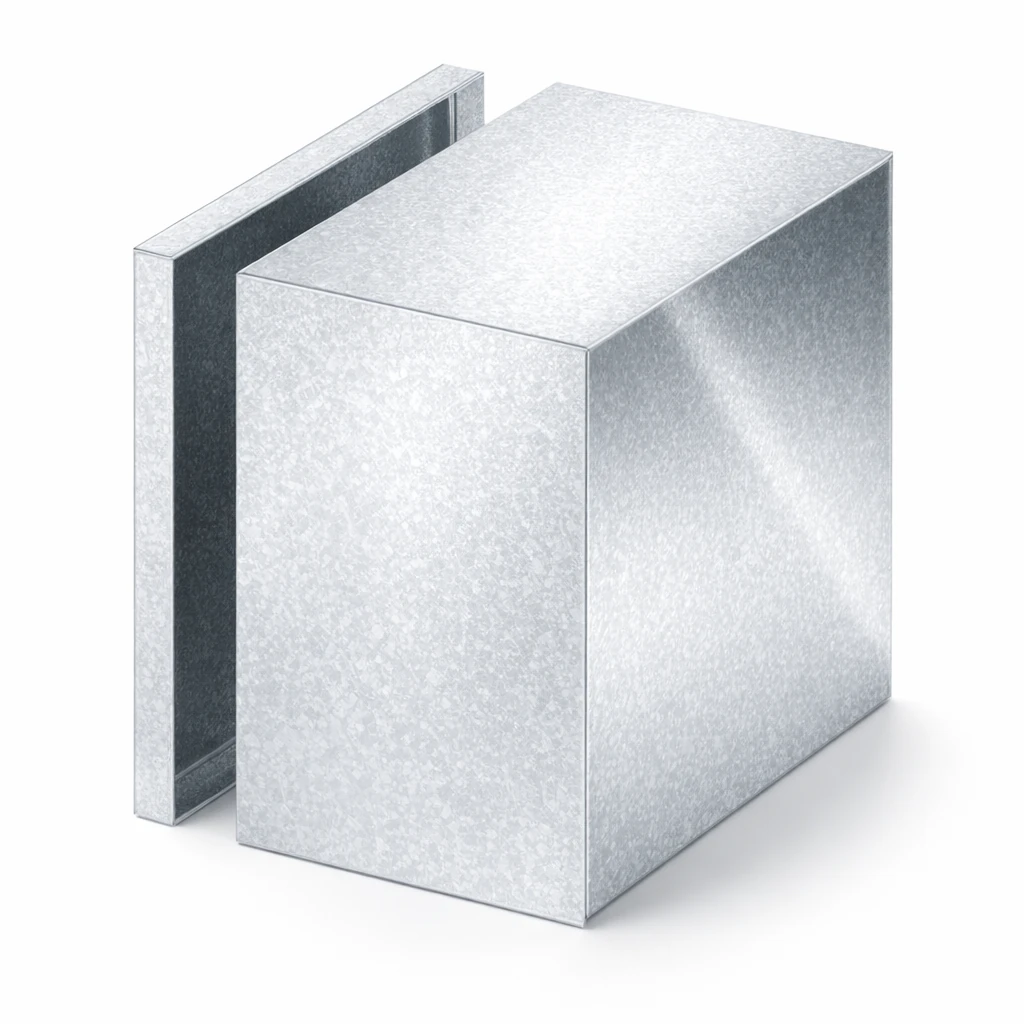
A plenum box is the sheet metal box that mounts on the furnace, air handler or AC coil and feeds the trunk ducts. We fabricate custom supply air plenums and return air plenums to your equipment opening in galvanized, aluminum or stainless steel. Set the width, depth and height below, watch it build in 3D, and see the price change as you type.
Looking for a specific size? See all 288 plenum box sizes we publish, with prices. Each size has its own page you can order from, in galvanized, aluminum and stainless.
Plenum Sizing Calculator
Enter the equipment discharge opening and the system airflow. We check the plenum velocity, count how many round takeoffs the airflow needs, and pick the shortest published plenum height that fits them. Then load it straight into the designer for a live price.
Specifications
- Width: 2" to 48"
- Depth: 2" to 48"
- Height: 4" to 60"
- Materials: Galvanized Steel, Aluminum, Stainless Steel
- Gauges: 26, 24, 22, 20
- Connections: Raw, Slip, Drive, TDC, Flanged
- Application: Supply and return air distribution
Ships in 1 business day. Every fitting is cut, formed and inspected in our Pittsburgh shop and leaves the next business day — not the one to three weeks most custom shops quote.
Popular Plenum Box Sizes & Prices
Width x depth is the equipment opening; height is the box. Slip-and-drive on the equipment end. Every row is its own orderable page; the full list of 288 sizes adds aluminum, stainless and the 12", 36" and 48" heights for each.
| Width x depth | Height | Material | Gauge | Price | Order |
|---|---|---|---|---|---|
| 12" x 8" | 18" | Galvanized | 24 ga | $65.96 | Order this size |
| 12" x 12" | 18" | Galvanized | 24 ga | $69.71 | Order this size |
| 14" x 12" | 18" | Galvanized | 24 ga | $71.58 | Order this size |
| 16" x 12" | 18" | Galvanized | 22 ga | $79.95 | Order this size |
| 16" x 16" | 18" | Galvanized | 22 ga | $84.01 | Order this size |
| 16" x 16" | 24" | Galvanized | 22 ga | $91.49 | Order this size |
| 18" x 14" | 18" | Galvanized | 22 ga | $83.93 | Order this size |
| 18" x 18" | 18" | Galvanized | 22 ga | $88.14 | Order this size |
| 18" x 18" | 24" | Galvanized | 22 ga | $96.56 | Order this size |
| 20" x 14" | 18" | Galvanized | 22 ga | $85.88 | Order this size |
| 20" x 16" | 18" | Galvanized | 22 ga | $88.06 | Order this size |
| 20" x 20" | 18" | Galvanized | 22 ga | $92.43 | Order this size |
| 20" x 20" | 18" | Aluminum | 22 ga | $141.18 | Order this size |
| 20" x 20" | 18" | Stainless | 22 ga | $189.93 | Order this size |
| 20" x 20" | 24" | Galvanized | 22 ga | $102.02 | Order this size |
| 20" x 20" | 36" | Galvanized | 22 ga | $134.28 | Order this size |
| 22" x 20" | 24" | Galvanized | 22 ga | $106.59 | Order this size |
| 24" x 16" | 24" | Galvanized | 22 ga | $101.48 | Order this size |
| 24" x 20" | 24" | Galvanized | 20 ga | $122.13 | Order this size |
| 24" x 24" | 24" | Galvanized | 20 ga | $133.02 | Order this size |
| 24" x 24" | 36" | Galvanized | 20 ga | $176.61 | Order this size |
| 30" x 20" | 24" | Galvanized | 20 ga | $137.56 | Order this size |
| 36" x 24" | 36" | Galvanized | 20 ga | $220.20 | Order this size |
Custom HVAC Plenum Boxes: The Complete Guide
A plenum, also called a plenum box, a supply plenum, a return plenum, a furnace plenum or a plenum chamber, is the rectangular sheet-metal box that bolts directly to the furnace, air handler or coil cabinet and turns the equipment's single opening into the beginning of the duct system. It is the one fitting on every job that has to match the equipment exactly, and the equipment opening is never quite the size the supply house's pre-made plenum comes in. Cabinets come in 14.5", 17.5", 21" and 24.5" widths from one manufacturer and different widths from the next; coil cases add their own flange; return drops come in from the side, the bottom or the back. That is why a plenum is the fitting customers most often tell us they could not buy off a shelf, and why this page exists.
Everything below is what we tell customers on the phone: what the plenum does, how supply and return plenums differ, how to size the box to the equipment and the airflow, how tall to make it so the takeoffs fit, which gauge and material to specify, how the ends connect, and how to measure the opening you have. If you already know your numbers, the designer above prices them instantly and the popular-sizes table links to a page for each common size.
What a plenum actually is
Geometrically the plenum is the simplest fitting we make: four flat panels formed into a rectangular box with Pittsburgh-locked corner seams, open on the equipment end and finished on the other end however the system needs. What makes it different from a piece of straight duct is what happens inside it. The air leaving a blower is anything but uniform; it comes off the wheel fast on one side and slow on the other, it has just been pushed through a heat exchanger or a coil, and it is spinning. The plenum is the box where that air slows down, spreads out across the full cross-section and settles into something the trunk and the branches can share evenly. A plenum that is too small, or too short, hands that turbulence straight into the first takeoffs, and the rooms on those branches get more air and more noise than the rooms at the far end of the trunk.
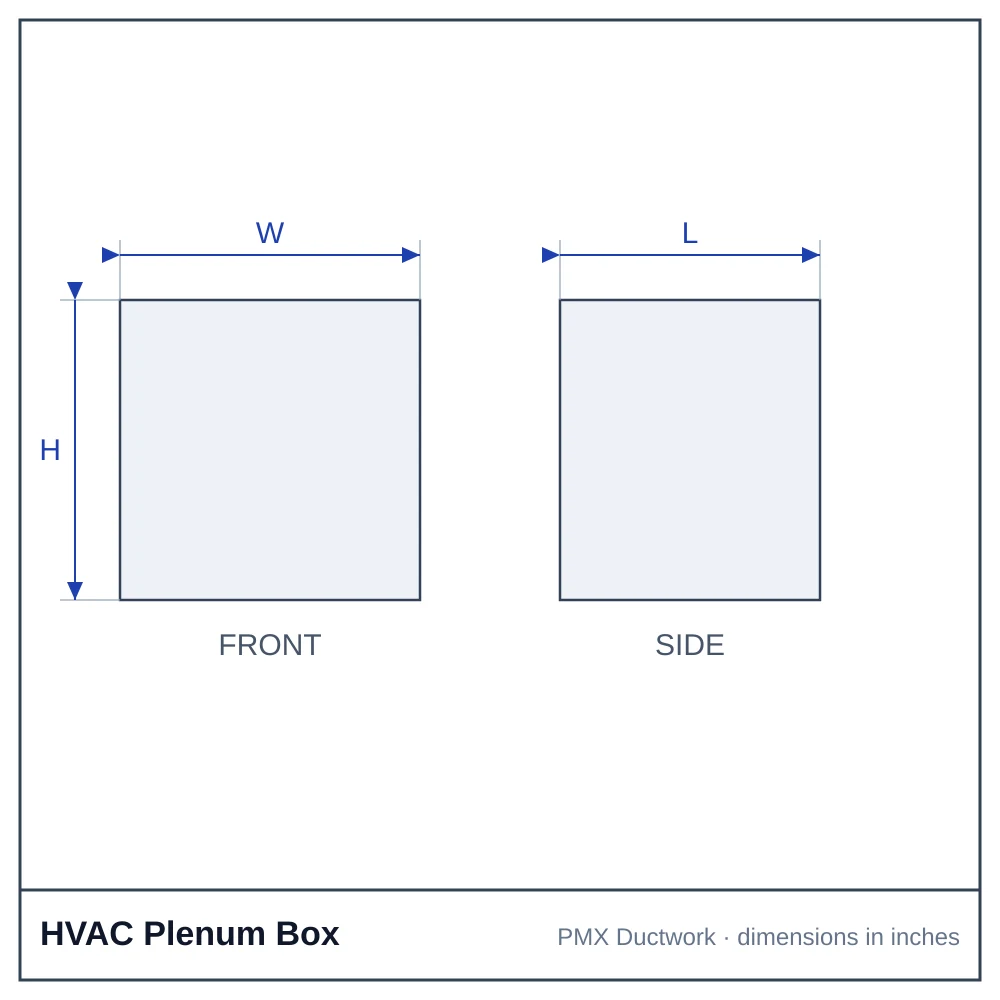
The three numbers that define the fitting are the width, the depth and the height. Width and depth are the outside dimensions of the box where it meets the equipment; height is how far it rises above the equipment flange before the trunk or the cap. The equipment end is finished for slip-and-drive connection to the furnace flange or a coil case, and the top can be a matching open end for a trunk, a reduced collar, or an end cap. Air can enter or leave either end, so the same box is a supply plenum on the discharge side and a return plenum on the inlet side.
Supply plenums and return plenums
- Supply plenum. Sits on the furnace discharge or above the evaporator coil and feeds the trunk duct, or carries the round branch takeoffs directly in a radial system. It sees the blower's full static pressure and the warmest air in the system, so it is the box that oil-cans and drums if it is under-gauged.
- Return plenum. Sits on the blower inlet, usually under an upflow furnace or beside a horizontal one, and collects air from the return trunk, the return drop or a filter rack. It runs at negative pressure, so leaks pull in basement or attic air instead of pushing conditioned air out, and a sagging panel here can be sucked against the filter. A return plenum is often larger than the supply because return velocity should stay lower to keep the grille quiet.
- Extended plenum. A tall supply plenum, 36" or 48", that replaces the first few feet of trunk. Branch takeoffs mount on the plenum itself, which is the layout of most radial basement systems and many small commercial units.
- Coil plenum and transition plenum. The box between the furnace and a cased or uncased coil, sized to the coil's flange rather than the furnace, sometimes with a taper on one side to step from one width to the other. Specify the smaller opening as the box and add a transition for the size change.
- Rooftop and air handler plenums. Commercial equipment with a supply and return opening on the same face, often needing TDC or flanged connections and heavier gauge. The same box, built to the drawing.
Sizing the plenum: match the opening, then check the velocity
The first rule is that the width and depth match the equipment discharge opening, because that is what the box has to slip over. The second rule is that the resulting cross-section has to carry the airflow at a reasonable velocity. Velocity in feet per minute is
V = CFM ÷ ( W × D ÷ 144 )
where W and D are the plenum inside dimensions in inches. For a quiet residential system keep the plenum under about 900 fpm; commercial low-pressure systems run higher. Some quick reference values:
| Plenum | Cross-section | CFM at 700 fpm | CFM at 900 fpm | Typical equipment |
|---|---|---|---|---|
| 14" x 14" | 1.36 sq ft | 950 | 1,225 | 2 to 2.5 ton, 14.5" cabinet |
| 16" x 16" | 1.78 sq ft | 1,245 | 1,600 | 2.5 to 3.5 ton |
| 16" x 20" | 2.22 sq ft | 1,555 | 2,000 | 17.5" cabinet, 3 to 4 ton |
| 18" x 18" | 2.25 sq ft | 1,575 | 2,025 | 3 to 4 ton |
| 20" x 20" | 2.78 sq ft | 1,945 | 2,500 | 21" cabinet, 4 to 5 ton |
| 24" x 20" | 3.33 sq ft | 2,335 | 3,000 | 24.5" cabinet, 5 ton |
| 24" x 24" | 4.00 sq ft | 2,800 | 3,600 | Light commercial |
| 30" x 24" | 5.00 sq ft | 3,500 | 4,500 | Light commercial |
If the equipment opening gives you a velocity above the target, the fix is not a bigger plenum on a smaller furnace; it is a short transition above the plenum to a larger trunk. If the opening gives you a velocity far below the target, which happens with a large coil case on a small furnace, that is fine; a slow plenum is a quiet plenum. The calculator at the top of this page reports the velocity for any opening and airflow, and if you do not know the CFM, a rule of thumb is 400 CFM per ton of cooling.
How tall to make it: fitting the takeoffs
Height is the dimension most people guess at, and it is the one that decides whether the takeoffs fit. Round takeoffs need about two inches of flat metal between collars so the crimped collar and the sealing flange do not overlap, two inches from any edge so the corner seam is not cut into, and the first row should sit at least six inches above the furnace flange so it does not pull from the turbulent zone right at the discharge. Add those up and you get the rule the calculator uses: the number of takeoffs that fit in one row is
per side = floor( ( side length − 2 ) ÷ ( takeoff diameter + 2 ) )
summed over the sides you can reach, and the minimum height is six inches of clearance plus one takeoff diameter plus two inches for each row you need. So a 20" x 20" plenum takes four 6" takeoffs per side in one row, and an 18" height fits one row of 6" or 7" takeoffs comfortably. Two rows of 8" takeoffs want 24" or 36". The published heights are 12", 18", 24", 36" and 48"; the calculator counts the takeoffs your airflow needs at a comfortable branch velocity, works out how many rows that takes on your opening, and returns the shortest published height that fits. If a side is against a wall or a chimney, mention it and we can put all the takeoffs on the reachable sides.
How many takeoffs the airflow needs is the other half of the count. At a comfortable branch velocity of about 600 fpm a 6" round carries about 118 CFM, a 7" about 160, and an 8" about 210. Divide the system CFM by that figure and round up. The calculator does this for the takeoff size you pick; it is a count of collars, not a duct design, and a Manual D or a room-by-room load will usually shift a few branches up or down a size.
Gauge
Sheet-metal gauge for low-pressure duct is set by the largest dimension of the fitting. The size pages on this site default to the gauge that a two-inch-water-column residential or light-commercial system would use: 24 gauge for plenums up to about 14" on the long side, 22 gauge to about 24", and 20 gauge above that. A plenum has large flat unbroken panels, sits on vibrating equipment, and takes the full blower static, so unlike a straight duct it benefits from going heavier rather than lighter: 24 gauge on a 20" x 20" plenum will drum when the blower starts and 22 gauge will not. Step up one gauge for rooftop units, anything a technician will stand on, medium-pressure systems, and any plenum that will carry a filter rack. Every size page lets you change gauge in the designer and the price updates on the spot.
Galvanized, aluminum or stainless
Galvanized steel is the standard for heating and cooling and is what nearly every plenum is made of. It is the least expensive, it takes duct sealant and tape well, and it is what the trunk and the branches are made of. Aluminum weighs about a third as much, does not rust, and is specified for pool and spa air handlers, coastal mechanical rooms, some laboratory work, and anywhere a large plenum has to be carried up a ladder or set on a rooftop by hand. Stainless steel is the material for commercial kitchen makeup air, chemical and process exhaust, washdown environments, and any box that will be exposed and must stay bright. Each material is priced live; the popular-sizes table above shows all three for the 20" x 20" x 18" so you can see the difference.
How the ends connect
The equipment end is finished with a slip-and-drive edge: the two long sides receive an S-cleat and the two short sides receive a drive cleat, so the plenum slips over the furnace flange or the coil case flange and is driven tight, then sealed with mastic. The top end is built the same way if a trunk continues, or is capped. If your system uses TDC or TDF flanges on the trunk, or the air handler has a raised flange that needs a matching raw edge, choose that connection in the designer or say so in the order notes. Round takeoffs are normally field-installed with a hole saw and a spin-in or a saddle collar; if you would rather have the holes cut and the collars riveted in the shop, send the layout and we build it that way. Seal every takeoff and the corner seams with mastic; the plenum is the highest-pressure box in the system and the one where leaks are most expensive.
How to measure the opening you have
- Width and depth: measure the outside of the flange the plenum will slip over, the furnace discharge or the top of the coil case, side to side and front to back. Give the plenum those dimensions; the slip-and-drive edge adds the connection allowance. If the coil case is wider than the furnace, size the plenum to the coil.
- Height: measure from the flange to the underside of the joist or the bottom of the trunk, subtract the trunk connection, and check that against the height the calculator gives for your takeoffs. If the space is short, an extended plenum can be turned into a shorter plenum plus a trunk.
- Which sides are reachable: note any side that is against a wall, a water heater or a chimney. Takeoffs go on the other three.
- Return side: a return plenum under an upflow furnace is measured at the blower inlet flange the same way, and its height is set by the filter rack or the return drop that comes into it.
Why field-made plenums go wrong
Every installer has built a plenum on the floor out of a sheet of duct, snapped the corners and hoped. It holds air. It also has four corners that were never locked, so it leaks at every one; it was bent by hand, so it does not sit square on the furnace and the drive cleats fight it; and it is usually a gauge too light, so it drums every time the blower starts. A shop-built plenum has Pittsburgh-locked corners, is square by construction, and comes in the gauge the size calls for. On a supply plenum the difference is audible in the mechanical room and measurable at the farthest register. On a return plenum it is the difference between the furnace breathing conditioned air and breathing the basement.
Plenum versus a straight duct, a transition, or a return boot
The names get used loosely, so here is how we use them. A straight duct is a length of rectangular trunk, open on both ends, meant to be joined in sections; a plenum is the box that starts the trunk and is sized to the equipment rather than to the airflow alone. A transition changes the rectangular size between the plenum and the trunk, tapered on one or more sides. A return boot is the fitting at the other end of the return duct, behind the grille, that turns a wall or floor opening into a duct connection. A plenum is the only one of the four that bolts to the equipment, and it is the one this page is about.
Ordering, price and turnaround
Set the width, depth and height in the designer, choose material and gauge, and the price shown is the price you pay; there is no quote step for standard configurations. Each plenum is made to order in our Pittsburgh shop from full sheets, so an unusual size costs the same as a common one of the same amount of metal, and quantity does not change the unit price the way it does for stamped fittings. Add the plenum to the cart with the rest of the job, or order any of the 288 published sizes from its own page. For shop-cut takeoffs, a filter rack, a tapered side, TDC flanges, or a takeoff of a drawing, call 412.725.2744 or email sales@pmxductwork.com with the dimensions and we will price it the same day we read it.
Read more
- Plenum boxes: purpose, sizing and installation: the velocity and static-pressure rules in more depth.
- Custom duct plenums made to order: what to specify and why the plenum sets up the whole system.
- Supply versus return ductwork: how the two plenums share the blower's static.
- Every published plenum size with its price.
Frequently Asked Questions
What is a plenum box used for?
A plenum is the sheet-metal box that sits directly on the furnace or air handler. The supply plenum takes the full airflow off the blower discharge and feeds it into the trunk duct or the round branch takeoffs; the return plenum collects air from the return duct or filter rack and delivers it to the blower inlet. Every cubic foot of air the system moves passes through both, which is why they are sized to the equipment rather than to any single room.
What size plenum do I need for my furnace?
Match the width and depth to the equipment discharge opening, then check the velocity: airflow in CFM divided by the plenum cross-section in square feet should stay under about 900 feet per minute for a quiet residential system. A 20" x 20" plenum is 2.78 square feet and carries 2,000 CFM at 720 fpm, which is why it is the most common residential supply size. The calculator on this page does the arithmetic and picks the nearest published height.
How tall should a supply plenum be?
Tall enough to fit every round takeoff with about two inches of clear metal between collars and at least two inches above the furnace flange, and tall enough for the air to settle before it reaches the trunk. Eighteen inches fits one row of 6" or 7" takeoffs on every side; 24" fits two staggered rows or 8" takeoffs with room to spare; 36" and 48" heights are for extended plenums that replace a short trunk. The calculator counts the takeoffs you need and returns the shortest published height that fits them.
How many takeoffs can I put on a plenum?
As many as fit with two inches of flat metal between the collars and two inches from every edge, on any of the four sides. A 20" x 20" x 18" plenum takes four 6" takeoffs per side in one row, sixteen in all. The limit that matters more is airflow: keep the total branch capacity in line with the blower CFM, and put the first takeoff at least six inches above the furnace so it does not pull from the turbulent zone at the coil.
Can each side of the plenum be a different size or connection?
Yes. The designer builds the box to your width, depth and height, and the connection on the equipment end can be raw, slip-and-drive, TDC or flanged. If you need the top reduced to a trunk size, an end cap, a filter rack or a takeoff cut and collared in the shop, say so in the order notes or call us with the drawing and we build it to that.
What gauge should a plenum be?
The published sizes default to 24 gauge galvanized up to about 14" on the long side, 22 gauge to about 24", and 20 gauge above that, which keeps the flat panels from oil-canning and drumming when the blower starts. Because the plenum carries the blower's full static and is bolted to vibrating equipment, it is worth one gauge heavier than the trunk it feeds. Change the gauge in the designer and the price updates.
Galvanized, aluminum or stainless for a plenum?
Galvanized steel for ordinary heating and cooling. Aluminum where the plenum has to be carried up a ladder or sits in corrosive, non-food air such as a pool or coastal mechanical room. Stainless steel for kitchen makeup air, laboratory and process systems, washdown areas and anywhere the box is exposed and has to stay bright. All three are priced live in the designer.
Can I get a plenum size that is not in your published list?
Yes. The 288 published sizes are the common furnace and air handler openings at five heights. The designer accepts any width, depth and height in quarter-inch steps, prices it instantly, and lets you add it to the cart. Every plenum is made to order, so an odd size costs the same as a common one of the same amount of metal.