Custom Duct End Caps, Made to Order in Any Size
Rectangular duct caps fabricated to the exact inside size of your trunk, branch or cleanout in galvanized, aluminum or stainless. Set the size below, watch it build in 3D, and see the price change as you type.
Looking for a specific size? See all 429 duct end cap sizes we publish, with prices. Each size has its own page you can order from, in galvanized, aluminum and stainless.

Specifications
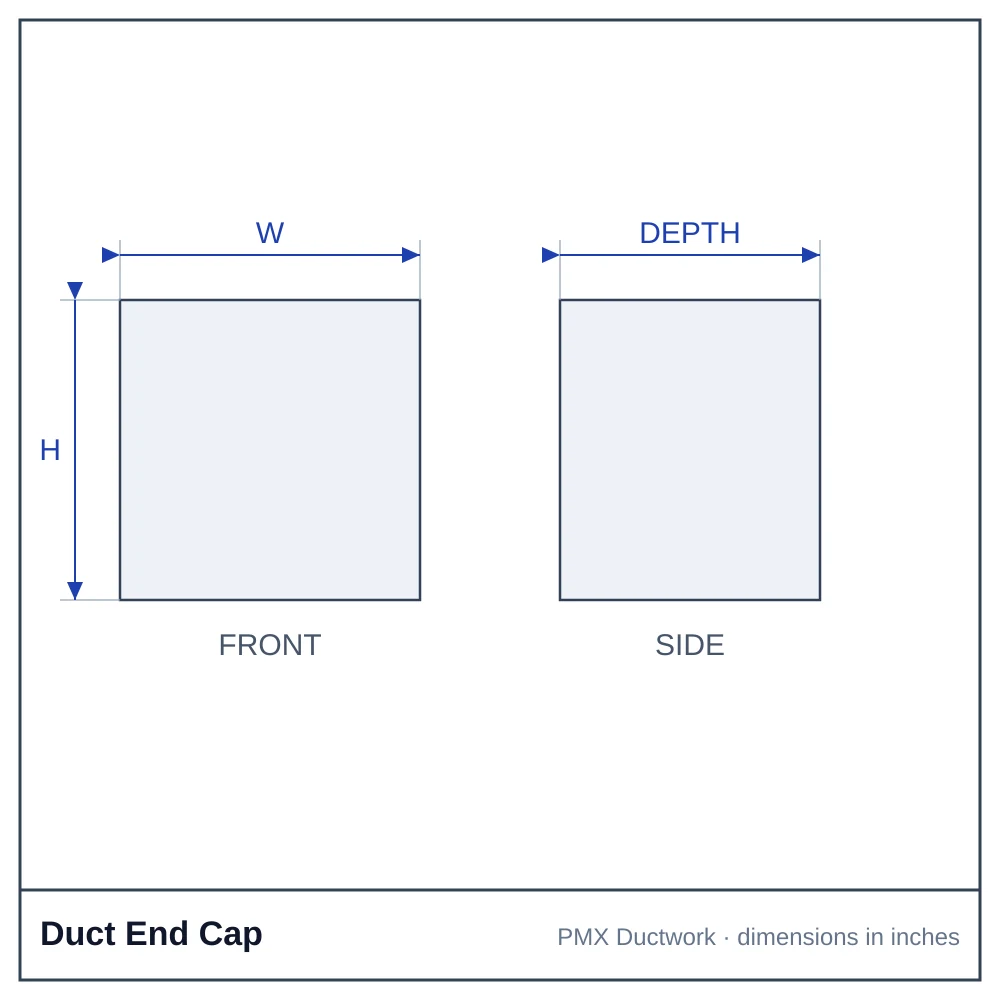
- Width: 2" to 48"
- Depth: 2" to 48"
- Collar: 2" slip-and-drive in published sizes
- Materials: Galvanized Steel, Aluminum, Stainless Steel
- Gauges: 26, 24, 22, 20
- Connections: Raw, Slip, Drive, TDC, Flanged
Ships in 1 business day. Every fitting is cut, formed and inspected in our Pittsburgh shop and leaves the next business day — not the one to three weeks most custom shops quote.
Popular Duct End Cap Sizes & Prices
2" slip-and-drive collar, gauge set by the long side. Every row is its own orderable page; the full list of 429 sizes adds aluminum and stainless for each.
| Size (W x D) | Material | Gauge | Price | Order |
|---|---|---|---|---|
| 6" x 6" | Galvanized | 26 ga | $29.91 | Order this size |
| 8" x 6" | Galvanized | 26 ga | $30.06 | Order this size |
| 8" x 8" | Galvanized | 24 ga | $34.80 | Order this size |
| 10" x 8" | Galvanized | 24 ga | $34.99 | Order this size |
| 10" x 10" | Galvanized | 24 ga | $35.20 | Order this size |
| 12" x 8" | Galvanized | 24 ga | $35.17 | Order this size |
| 12" x 10" | Galvanized | 24 ga | $35.42 | Order this size |
| 12" x 12" | Galvanized | 24 ga | $35.67 | Order this size |
| 14" x 8" | Galvanized | 24 ga | $35.36 | Order this size |
| 14" x 10" | Galvanized | 24 ga | $35.64 | Order this size |
| 16" x 10" | Galvanized | 24 ga | $35.86 | Order this size |
| 16" x 12" | Galvanized | 22 ga | $42.67 | Order this size |
| 18" x 12" | Galvanized | 22 ga | $42.92 | Order this size |
| 20" x 12" | Galvanized | 22 ga | $43.17 | Order this size |
| 20" x 14" | Galvanized | 22 ga | $43.54 | Order this size |
| 24" x 12" | Galvanized | 22 ga | $43.67 | Order this size |
| 24" x 18" | Galvanized | 22 ga | $44.98 | Order this size |
| 30" x 18" | Galvanized | 20 ga | $55.76 | Order this size |
| 36" x 24" | Galvanized | 20 ga | $58.66 | Order this size |
| 48" x 24" | Galvanized | 20 ga | $61.28 | Order this size |
| 12" x 10" | Aluminum | 24 ga | $74.42 | Order this size |
| 12" x 10" | Stainless | 24 ga | $113.42 | Order this size |
| 20" x 12" | Aluminum | 22 ga | $91.92 | Order this size |
| 20" x 12" | Stainless | 22 ga | $140.67 | Order this size |
Custom Duct End Caps: The Complete Guide
A duct end cap, also called a duct cap, a blank-off, an end plate, a cleanout cap or a duct plug, is a flat plate with a short collar that closes the open end of a rectangular duct. It is the simplest fitting in the trade and one of the most often done wrong: the end of an extended-plenum trunk gets folded over and taped, an unused branch collar gets a square of sheet screwed across it, and a cleanout on a dust collector gets a piece of plywood. Every one of those leaks, and the trunk end in particular is usually the largest single leak in a house. A shop-made cap slips inside the duct, takes the same S-cleat and drive cleat as any rectangular joint, seals with a bead of mastic, and stays sealed for the life of the system. Every end cap on this page is cut and formed to the size you enter in the designer above, priced as you type, and made to order in our Pittsburgh shop.
This guide covers what the cap is, where it goes, how to size it, why the trunk end matters so much for leakage, how to use a cap as a cleanout, which gauge and material to specify, how it connects and seals, how to measure for it, and how it relates to the other fittings on the site. If you already know the size, the designer prices it instantly and the popular-sizes table links to a page for each common size.
What a duct end cap actually is
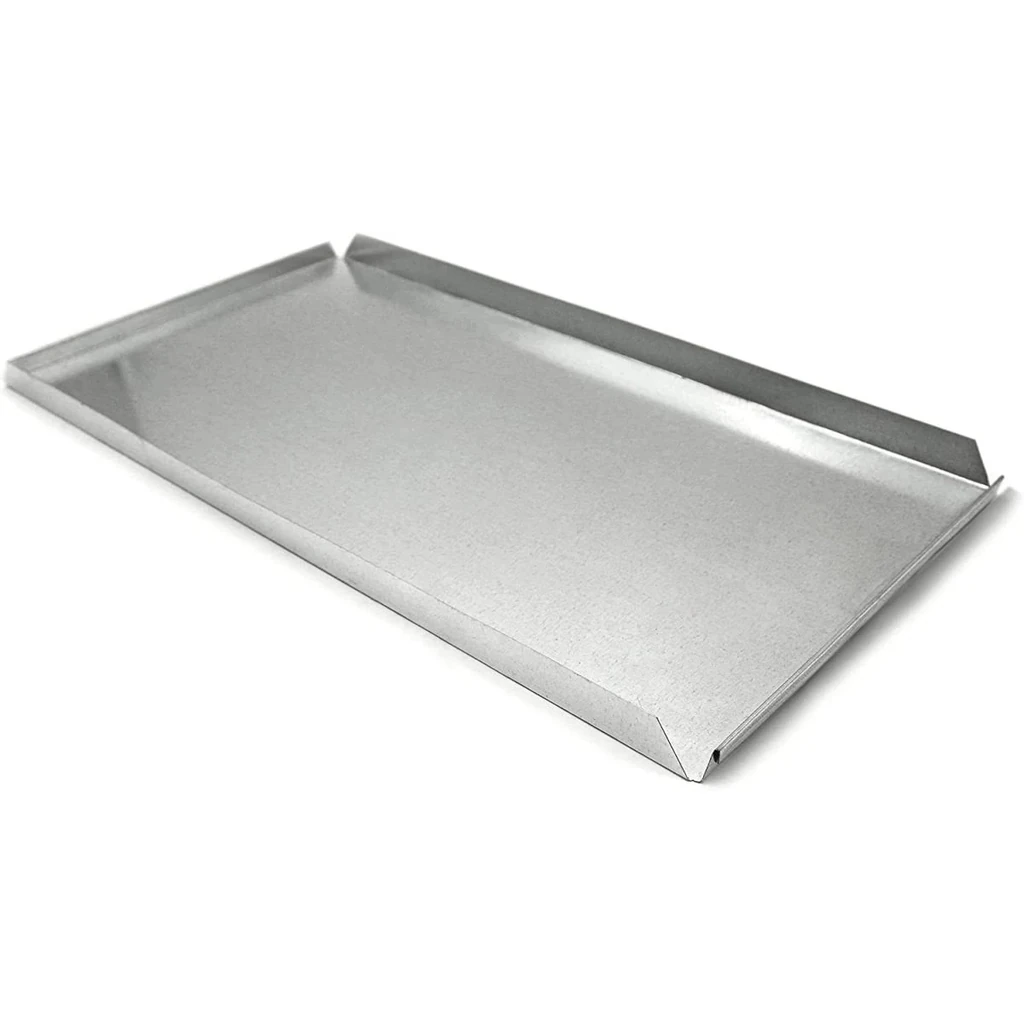
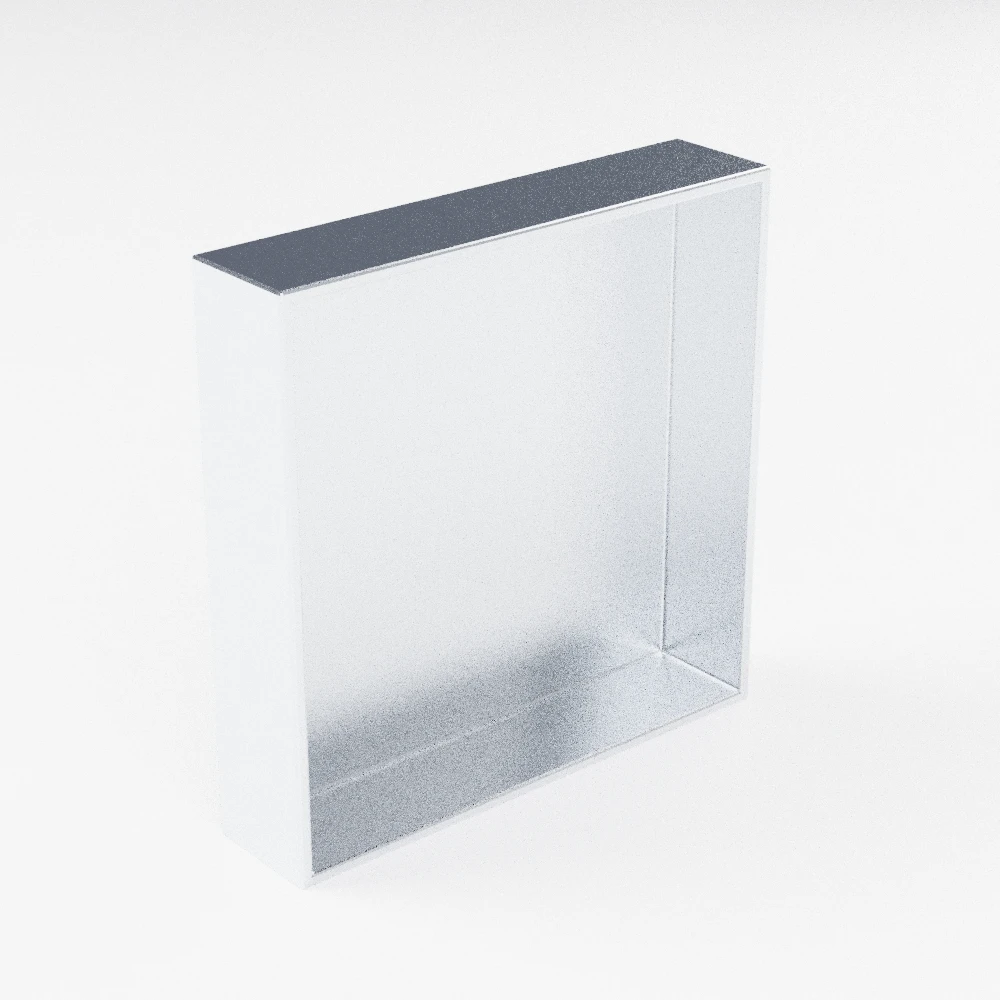
The cap is a rectangular blank plate with a 2" collar formed around all four edges. The collar is sized to the inside of the duct it closes, with the slip-and-drive allowance built in, so it slides into the open end of the duct and the two long edges take S-cleats while the two short edges take drive cleats, exactly as a joint between two sections of duct does. Once cleated the cap is as rigid as the duct itself and the joint is sealed the same way. On TDC and flanged duct the cap is made with a matching flange instead of a slip collar, and a raw edge is available where the cap will be screwed and sealed to a raw duct end. The two numbers that define the fitting are the inside width and depth of the duct; there is nothing else to specify except material, gauge and the connection type.
Where duct end caps are used
- The end of a supply trunk. An extended-plenum trunk runs past the last takeoff and ends; the end must be closed airtight. This is the most common use and the one most often botched in the field.
- The end of a return trunk. Same requirement on the suction side, where an open end pulls attic or crawlspace air straight into the system.
- An unused branch collar. A tee or cross installed for a future room, or a collar left when a register is abandoned, gets a cap until it is needed.
- Cleanouts. A capped stub at the end of a dust-collection or exhaust header, or at the bottom of a drop, gives access for cleaning without cutting the duct.
- Blanking a plenum opening. A plenum with a collar that is not used on this job, or a coil box opening that a different equipment configuration leaves open.
- Temporary closure during construction. Capping open duct ends while a building is finished keeps drywall dust and debris out of the system; pull the caps and the system is clean.
- Pressure testing. Duct leakage testing requires every opening sealed; caps on the trunk ends and register collars are how it is done.
Sizing: the nominal inside size of the duct
Order the cap in the same nominal size as the duct it closes. A 12" x 10" trunk takes a 12" x 10" cap; a 20" x 12" trunk takes a 20" x 12" cap. The collar is made to fit inside that duct with the slip-and-drive allowance built in at the shop, so you do not subtract anything. Measure the inside width and the inside depth of the duct at the open end, enter those two numbers, and choose the connection that matches the duct end. If the duct end is a raw cut, order a slip-and-drive cap and a set of cleats, or a raw-edge cap to be screwed and sealed. If the duct is TDC, order a TDC cap. The designer will take any size from 2" to 48" in either dimension, and the published size pages cover the sizes that match the straight duct sizes on the site.
Why the trunk end is the leak that matters
Duct leakage testing on existing houses routinely finds the largest single leak at the end of the supply trunk. The reason is mechanical: a trunk end that was folded over and taped had its four sides bent at different angles, the corners never met, and the tape that covered the gaps dried and let go within a few years. On a supply trunk that leak dumps conditioned air into the basement or attic at full trunk static pressure; on a return it pulls unconditioned air into the system before the filter. The fix is a cap that seals like a joint, which is what a shop end cap is: a rigid plate, four cleated edges, and a mastic bead. Installed that way the trunk end contributes nothing to the leakage number, and the difference on a duct leakage test is measurable. The duct sealing methods and duct leakage testing articles cover the numbers.
Using an end cap as a cleanout
On dust collection, sawdust, process exhaust and commercial kitchen exhaust systems the duct fills with material and has to be cleaned. The standard cleanout is a short capped stub at the end of every header and at the bottom of every vertical drop: pull the two drive cleats, slide the cap out, clean the duct, slide the cap back and replace the cleats. It costs a few dollars of metal and it makes the duct serviceable for its whole life. Order the cleanout cap in the same material and gauge as the header, so it does not corrode at the joint and so it stands up to being removed and replaced. For grease exhaust the cap must be stainless and the joint must be sealed with a grease-rated sealant. Where a hinged, gasketed access door is needed on the side of a duct rather than a cap on the end, call us and describe the opening.
Gauge
Match the gauge of the duct the cap closes. The published size pages on this site default to 26 gauge for caps up to 8" on the long side, 24 gauge from 8" to 20", 22 gauge from 22" to 36", and 20 gauge for caps from 38" to 48", which is the same schedule as straight rectangular duct on the site. A cap is a flat unbroken plate, and a large flat plate in a light gauge drums when the blower starts and stops, so on a cap over about 24" wide that sits at the end of an exposed trunk, or on any medium-pressure system, one gauge heavier than the duct is money well spent. The designer lets you change the gauge and the price updates on the spot.
Galvanized, aluminum or stainless
Match the duct. Galvanized steel is the standard for heating and cooling duct and is what most caps are made of. Aluminum for rooftop duct, pool and spa air handlers and coastal installations, and where the cap must be handled often and weight matters. Stainless steel for commercial kitchen grease exhaust, laboratory and process exhaust, washdown environments, and any exposed cap that must stay bright. A cap in a different metal than the duct it sits in sets up a galvanic couple at the joint that will corrode in a damp location, so keep them the same. Each material is priced live; the popular-sizes table above shows all three for two common sizes.
Connections and sealing
The published caps carry a 2" slip-and-drive collar. To install: slide the cap into the duct end, slip an S-cleat over the top and bottom edges, drive a drive cleat down each side, bend the tabs over, and run a bead of mastic or UL 181 foil tape around all four edges and over the corners. That is the same procedure as a transverse joint and the result is the same: a joint that holds at any pressure a residential or light-commercial system can produce. On TDC duct, order a TDC cap and bolt it on with the same corners and gasket as the rest of the run. Where the cap has to come off for cleaning, cleat it without mastic and use a removable sealant or a gasket, so it can be pulled without tools beyond a screwdriver for the tabs. The designer offers raw, slip, drive, TDC and flanged edges so the cap matches whatever is on the duct.
How to measure the cap you need
- Inside width and depth: measure the inside of the duct at the open end, both dimensions, and enter them. Do not subtract for the collar; that allowance is built in.
- Connection: look at how the rest of the duct is joined and match it. Slip-and-drive is standard; TDC and flanged are available.
- Material and gauge: match the duct, or go one gauge heavier on a large exposed cap.
- Quantity: a trunk system has at least two ends, every future-branch collar needs one, and cleanout systems need one per header and drop. Count the openings.
Capping a future branch instead of cutting in later
When a house or a tenant space is likely to grow, the cheapest time to provide for the extra branch is when the trunk goes in. A tee or a cross with the future collar capped costs a fraction of what it costs to cut a takeoff into a finished, insulated trunk above a finished ceiling, and the capped collar is airtight until the day it is needed. The same logic applies to a plenum ordered with one more collar than the job needs today. When the room is added, pull the drive cleats, slide the cap out, and the branch duct goes straight onto a shop-made collar that was sized and sealed from the start. Order the cap in the branch collar's nominal size; it is the same fitting as a trunk cap, only smaller.
Caps on round and oval duct
This page is for rectangular caps, which are the ones that go missing on a job because every size is different. Round duct ends are closed with a round cap that slips over or into the pipe, and those are stocked at most supply houses in the common diameters. If a rectangular trunk transitions to round before it ends, close the round end with a round cap; if it ends rectangular, cap it here. For a rectangular trunk that reduces and then ends, the reducer takes the trunk down and the smaller cap closes it; order the cap in the reduced size.
A note on temporary caps during construction
Drywall dust, sawdust and insulation fibers that get into an open duct during construction end up in the coil, the blower wheel and the first filter change, and a system started up with a dirty trunk never quite loses the smell. Capping every open end and every register collar before the drywall goes up, and pulling the caps at trim-out, costs a few dollars per opening and is the difference between a clean startup and a service call. Because the caps are cleated and not sealed at this stage, they come off in a minute with a screwdriver, and the trunk-end caps stay on permanently with a mastic bead added at trim-out. On a job that will be leakage tested, the same caps close the register collars during the test.
What a shop-made cap costs versus the field alternative
A shop cap is the least expensive fitting on this site, and a folded and taped duct end is not free either: it takes a tradesman ten or fifteen minutes on a ladder with snips, a hand brake and a roll of tape, and the result leaks. The published sizes in the table above show what a cap costs in each material; add the caps to an order of trunk and fittings and they ship with the rest of the job in the same crate. For a system with many cleanouts or many future branches, order the caps in the same material and gauge as the duct in one line and they will match. Because each cap is cut from the same sheet stock as the trunk it closes, the fit is the same as a trunk joint, and an installer who has cleated one section of duct already knows how to install it: no special tools, no adapter, no field forming, and no return trip to seal a leak that a shop cap never had.
End cap versus a folded end, a plenum, or a reducer
A folded-and-taped duct end is not a substitute for a cap; it leaks from the day it is made and gets worse. A plenum is a box with collars meant to sit on equipment and is not a way to close a trunk. A reducer steps a trunk down to a smaller size and is the right fitting when the trunk continues at a smaller size rather than ending; the trunk still needs a cap at its far end. A transition changes shape and does not close anything. If the duct simply stops, the fitting is an end cap, and it is the least expensive fitting on this site.
Ordering and price
Set the width and depth in the designer, choose material, gauge and connection, and the price shown is the price you pay; there is no quote step. Each cap is made to order in our Pittsburgh shop, so an unusual size costs the same as a common one of the same amount of metal. Add the caps to the cart with the rest of the job, or order any of the 429 published sizes from its own page. Most orders for caps are for several at once, one per open end, so count the ends before you order. For an access door, a gasketed removable cap, a cap with a test port or a drain, or a takeoff from a drawing, call 412.725.2744 or email sales@pmxductwork.com with the dimensions.
Read more
- Duct end caps and cleanouts: terminating runs and keeping them serviceable.
- Duct sealing methods: mastic, tape and where each belongs.
- Duct leakage testing: how the trunk end shows up in the test.
- Duct connection types explained: slip-and-drive, TDC and flanged.
- Every published duct end cap size with its price.
Frequently Asked Questions
What is a duct end cap?
A flat blank plate with a short collar, sized to the inside of a rectangular duct, that closes off the open end of a trunk, an unused branch collar or a cleanout opening. The collar slips into the duct and is joined with the same S-cleat and drive cleat as any rectangular joint, then sealed. It is the correct way to terminate a duct run instead of folding the duct end over or taping a piece of sheet across it.
What size end cap do I need?
Order the nominal inside size of the duct it caps: a 12" x 10" trunk takes a 12" x 10" end cap. The cap is made to fit inside that duct with the slip-and-drive allowance built in at the shop, so measure the inside width and depth of the duct and enter those two numbers.
Should I cap the end of a supply trunk?
Yes, always. An extended plenum trunk ends past the last takeoff and that end must be closed airtight, otherwise the last few feet of trunk become the biggest leak in the system. A shop end cap cleated and sealed with mastic is airtight; a folded and taped duct end is not and will open up as the tape ages.
Can an end cap be used as a cleanout or access cover?
Yes. On dust collection, exhaust and kitchen exhaust systems a capped stub at the end of a header or at the bottom of a drop is the standard cleanout: pull the drive cleats, remove the cap, clean the duct, replace it. Order it in the same material and gauge as the header. For a hinged or gasketed access door on the side of a duct rather than the end, call us.
What gauge should an end cap be?
Match the duct it closes. The published size pages on this site default to 26 gauge up to 8" on the long side, 24 gauge from 8" to 20", 22 gauge from 22" to 36" and 20 gauge for 38" to 48" caps, the same schedule as straight rectangular duct. A large flat cap in a light gauge can drum when the fan cycles; go one gauge heavier on a cap over about 24" if the trunk is exposed or the system is medium pressure.
What connections are available?
The published sizes carry a 2" slip-and-drive collar, which matches rectangular duct with S-cleat and drive-cleat joints. The designer also offers plain slip, raw, TDC flange and flanged edges so the cap matches whatever is on the end of the duct it closes.
Galvanized, aluminum or stainless: which material?
Match the duct. Galvanized steel for ordinary heating and cooling duct, aluminum for rooftop, coastal and pool-area duct, and stainless steel for kitchen grease exhaust, laboratory and process exhaust and washdown areas. A cap in a different metal than the duct it sits in can corrode at the joint, so keep them the same.
Can I get a size that is not in your published list?
Yes. The 429 published sizes are the common ones. The designer accepts any width and depth in quarter-inch steps, prices it instantly, and adds it to the cart. Every cap is made to order, so an odd size costs the same as a common one of the same amount of metal.