Custom Return Air Boots, Made to Order for Any Grille Size
Return duct boots fabricated to your exact grille opening, duct mouth and throat in galvanized, aluminum or stainless. Set the size below, watch it build in 3D, and see the price change as you type.
Looking for a specific size? See all 222 return air boot sizes we publish, with prices. Each size has its own page you can order from, in galvanized, aluminum and stainless.
Return Grille and Boot Velocity Calculator
Enter the grille opening and the return airflow. We compute the grille's free area, the face velocity through it, the velocity in the boot mouth, and the smallest grille that keeps the return under 500 feet per minute. Then load the boot straight into the designer for a live price.
Specifications
- Grille Width: 4" to 48"
- Grille Height: 4" to 36"
- Duct Mouth: 4" to 48"
- Throat Length: 2" to 36"
- Materials: Galvanized Steel, Aluminum, Stainless Steel
- Gauges: 26, 24, 22, 20
- Connections: Raw, Slip, Drive, TDC, Flanged
- Application: Wall, floor and ceiling return grilles to the return duct
Ships in 1 business day. Every fitting is cut, formed and inspected in our Pittsburgh shop and leaves the next business day — not the one to three weeks most custom shops quote.
Popular Return Air Boot Sizes & Prices
Width x height is the grille opening; the duct mouth matches it. Slip-and-drive on the duct end. Every row is its own orderable page; the full list of 222 sizes adds aluminum and stainless for each.
| Grille opening | Gross area | Material | Gauge | Price | Order |
|---|---|---|---|---|---|
| 8" x 6" | 48 sq in | Galvanized | 26 ga | $39.62 | Order this size |
| 10" x 6" | 60 sq in | Galvanized | 24 ga | $45.53 | Order this size |
| 10" x 8" | 80 sq in | Galvanized | 24 ga | $46.66 | Order this size |
| 12" x 6" | 72 sq in | Galvanized | 24 ga | $46.88 | Order this size |
| 12" x 8" | 96 sq in | Galvanized | 24 ga | $48.10 | Order this size |
| 12" x 10" | 120 sq in | Galvanized | 24 ga | $49.32 | Order this size |
| 12" x 12" | 144 sq in | Galvanized | 24 ga | $50.54 | Order this size |
| 14" x 8" | 112 sq in | Galvanized | 24 ga | $49.54 | Order this size |
| 14" x 10" | 140 sq in | Galvanized | 24 ga | $50.85 | Order this size |
| 14" x 14" | 196 sq in | Galvanized | 22 ga | $59.97 | Order this size |
| 16" x 10" | 160 sq in | Galvanized | 24 ga | $52.39 | Order this size |
| 16" x 12" | 192 sq in | Galvanized | 22 ga | $60.29 | Order this size |
| 16" x 16" | 256 sq in | Galvanized | 22 ga | $63.09 | Order this size |
| 18" x 10" | 180 sq in | Galvanized | 22 ga | $60.42 | Order this size |
| 18" x 12" | 216 sq in | Galvanized | 22 ga | $61.91 | Order this size |
| 20" x 8" | 160 sq in | Galvanized | 22 ga | $60.38 | Order this size |
| 20" x 10" | 200 sq in | Galvanized | 22 ga | $61.96 | Order this size |
| 20" x 12" | 240 sq in | Galvanized | 22 ga | $63.54 | Order this size |
| 20" x 12" | 240 sq in | Aluminum | 22 ga | $112.29 | Order this size |
| 20" x 12" | 240 sq in | Stainless | 22 ga | $161.04 | Order this size |
| 24" x 12" | 288 sq in | Galvanized | 22 ga | $66.79 | Order this size |
| 24" x 14" | 336 sq in | Galvanized | 22 ga | $69.73 | Order this size |
| 30" x 12" | 360 sq in | Galvanized | 22 ga | $76.74 | Order this size |
| 30" x 16" | 480 sq in | Galvanized | 20 ga | $98.68 | Order this size |
Custom Return Air Boots: The Complete Guide
A return air boot, also called a return boot, a return duct boot, a grille boot, a register boot when it is on the supply side, or a return box, is the sheet-metal box behind a return grille that turns the wide, shallow opening in a wall, floor or ceiling into a duct connection. It is the fitting that has to match two things that were sized by different people: the grille, which was picked for the room and the wall it sits in, and the duct, which was sized for the airflow. Grilles come in dozens of nominal sizes, joist bays and stud bays come in a few, the duct comes off in one of four directions, and the combination on any given return is one of hundreds. That is why customers tell us we are one of the very few shops that will build a boot to the exact grille and duct they type in, and why this page exists.
Everything below is what we tell customers on the phone: what the fitting is, why return boots are so often custom, how to size the grille and the boot so the return is quiet, what the throat does, which gauge and material to specify, how the ends connect, and how to measure the opening you have. If you already know your numbers, the designer above prices them instantly and the popular-sizes table links to a page for each common size.
What a return boot actually is
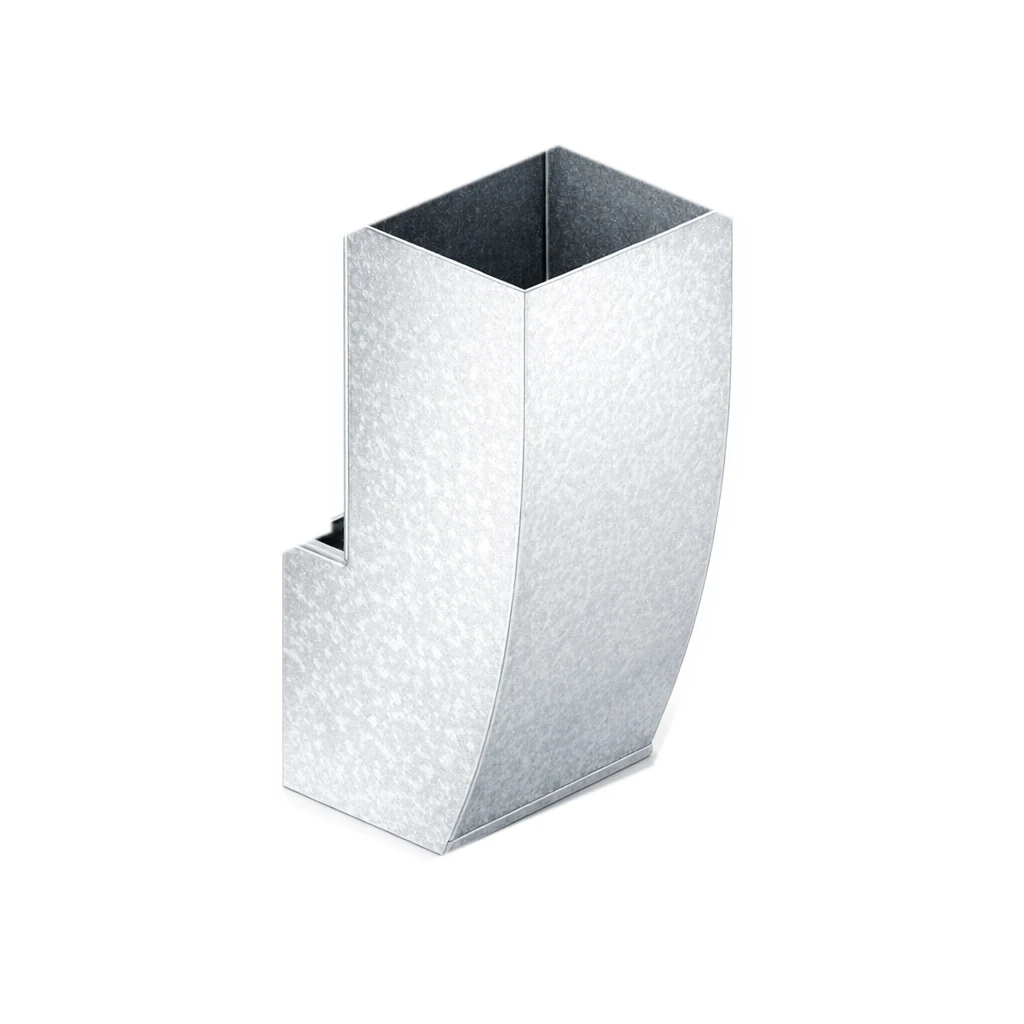
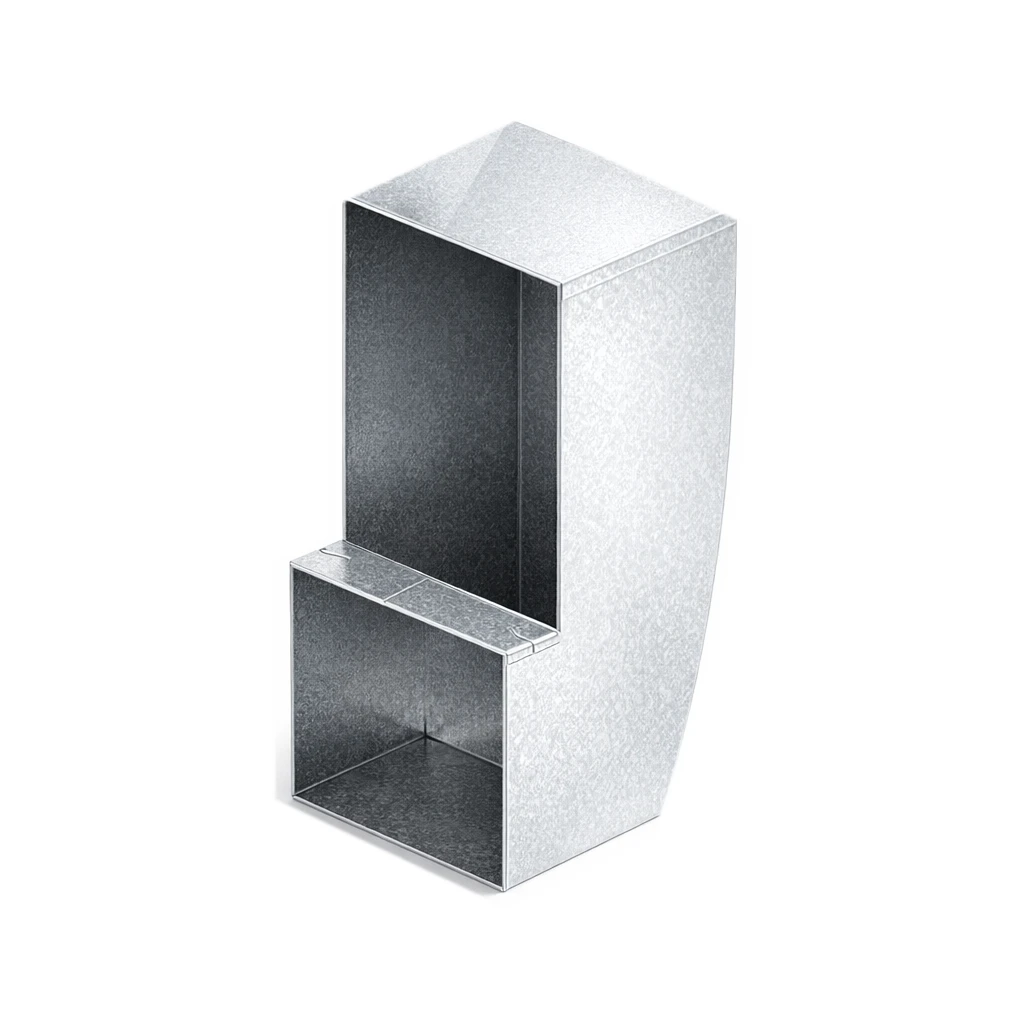
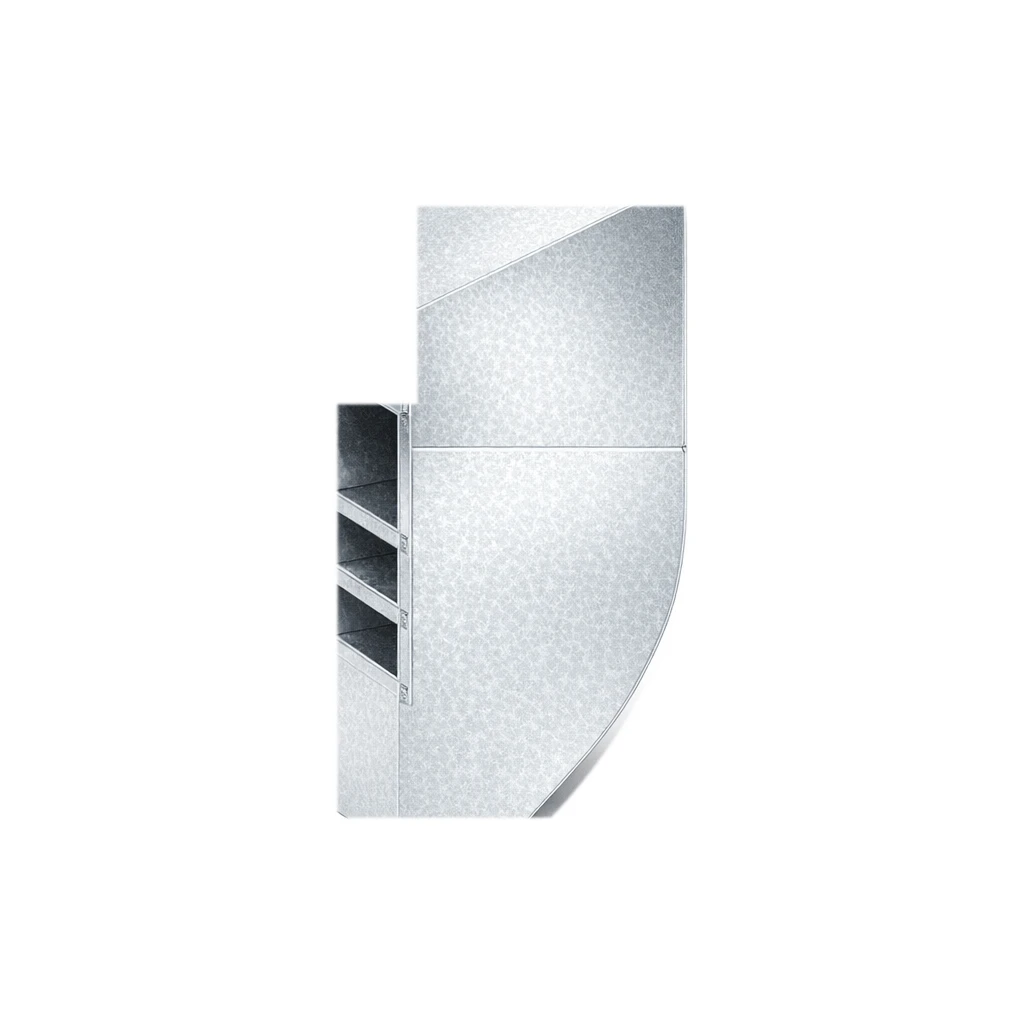
Geometrically the fitting is a rectangular box with two mouths. The grille mouth is the full size of the grille opening and has a flange or a raw edge that the grille screws to through the drywall or the floor. The duct mouth is the size of the return duct and leaves the box through the back, the end, or the top depending on where the duct runs. Between them is the throat, the straight run of box that gives the air room to turn the corner from the grille into the duct without slamming into the back wall. The corners are Pittsburgh-locked in the shop and the box is one piece; there is no field-cut collar and no separate elbow. Our designer builds the flat pattern from the grille opening, the duct mouth and the throat, the shop forms and seams it, and the boot arrives square, sealed and ready to screw to the framing.
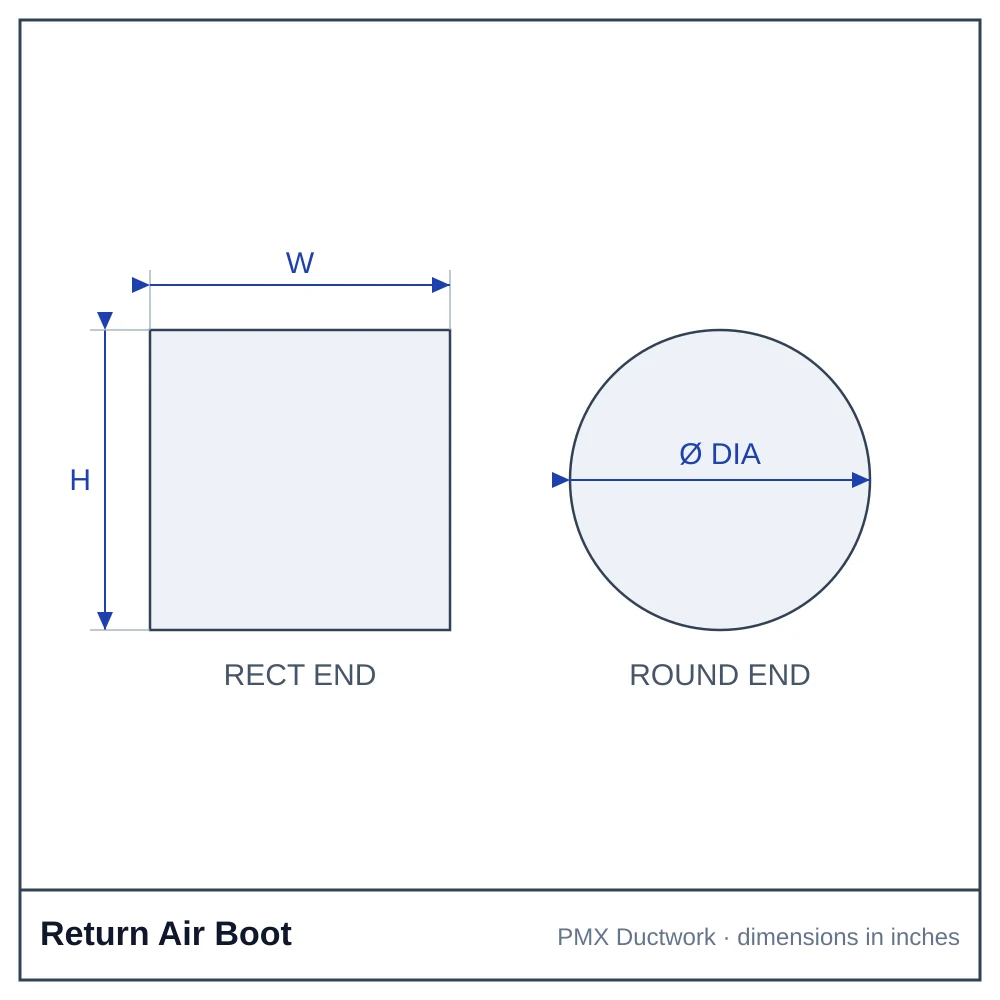
The numbers that define the fitting are the grille width, the grille height, the duct mouth width, and the throat length from the grille face to the far wall of the box. The duct mouth is finished for slip-and-drive connection to the return trunk or a return drop, or TDC or flanged if the system uses them. The same box works on the supply side as a large register boot, where a rectangular supply duct feeds a wall or ceiling register, and it works installed in either direction.
Where return boots are used
- Central wall return. The single large return in a hallway wall of a ranch or a two-story, typically a 20" x 20", 24" x 20" or 30" x 16" grille, with the boot dropping into the joist space below or the stud bay behind. This is the return that carries the whole system's airflow and the one that is most often undersized.
- Floor return. A grille in the floor over a joist bay, with the boot sized to the bay width and the duct leaving the end or the bottom. Common in older houses where the return runs in a panned joist bay to the furnace.
- Ceiling return. A grille in a hallway ceiling below an attic air handler, the boot rising into the attic to a return trunk or a flex connection.
- Bedroom and room returns. Smaller boots, 12" x 6" to 14" x 8", where each room has its own return instead of relying on door undercuts; sizing here is per room rather than per system.
- Filter grille returns. A boot behind a filter grille, where the grille's free area is lower and the boot has to be sized a step larger to keep the velocity down.
- Supply register boots. The same box behind a large rectangular supply register, a 24" x 6" or 30" x 6" linear grille, fed by rectangular duct. For a small floor register on round pipe a stamped boot is the right part; for anything rectangular-to-rectangular, or any nonstandard size, this is.
Sizing the return: keep the face velocity down
The rule that resolves nearly every return boot question is that the return has to move the whole system's airflow at a velocity low enough to be quiet. On the supply side the registers are small and the air is meant to throw; on the return side the grille is large and the air is meant to disappear. The number that matters is the face velocity through the grille's free area:
Vface = CFM ÷ ( W × H × free-area fraction ÷ 144 )
where W and H are the grille opening in inches and the free-area fraction is how much of the grille is actually open, about 0.7 for a stamped return grille, 0.75 for a bar grille, and 0.6 or less for a filter grille. Keep the face velocity under about 500 feet per minute for a return in a living space, and under 400 near a bedroom. Some quick reference values at 70% free area:
| Grille opening | Gross area | Free area | CFM at 400 fpm | CFM at 500 fpm |
|---|---|---|---|---|
| 12" x 6" | 72 sq in | 50 sq in | 140 | 175 |
| 14" x 8" | 112 sq in | 78 sq in | 218 | 272 |
| 16" x 10" | 160 sq in | 112 sq in | 311 | 389 |
| 20" x 12" | 240 sq in | 168 sq in | 467 | 583 |
| 24" x 12" | 288 sq in | 202 sq in | 560 | 700 |
| 20" x 20" | 400 sq in | 280 sq in | 778 | 972 |
| 24" x 20" | 480 sq in | 336 sq in | 933 | 1,167 |
| 30" x 16" | 480 sq in | 336 sq in | 933 | 1,167 |
| 30" x 20" | 600 sq in | 420 sq in | 1,167 | 1,458 |
You will notice that a 1,200 CFM three-ton system, which is fed by a 20" x 20" supply plenum, wants a 24" x 20" or 30" x 20" return grille, or two smaller ones. That is normal and it is the single most common mistake on the return side: the return is sized like the supply, the grille runs at 800 fpm, and the whole house hears the blower. The boot mouth is the grille opening, so once the grille is sized the boot is sized; the velocity in the boot's gross area is lower than the face velocity by the free-area fraction and is rarely the problem. The calculator at the top of this page does the arithmetic, shows both velocities, and reports the smallest grille that keeps the return under 500 fpm at the free area you pick. If you do not know the CFM, a rule of thumb is 400 CFM per ton of cooling, and the return should carry all of it.
The throat and the turn
Air entering a return grille has to turn 90 degrees to get into a duct that leaves the back or the end of the box, and it does not do that quietly if the box is shallow. A boot with a three-inch throat and the duct mouth right behind the grille makes the air hit the back wall and rumble; the same grille on a boot with a six- or eight-inch throat is noticeably quieter, because the air has room to slow and turn. The throat length in the designer is the straight run from the grille face to the far wall; make it as long as the joist bay or the stud depth allows. On a very large central return, over about 600 CFM through one grille, a single turning vane in the boot is worth specifying; mention it in the order notes. Where the duct leaves the end of the boot in line with the grille rather than behind it, there is no turn and the throat can be short.
Gauge
Sheet-metal gauge for low-pressure duct is set by the largest dimension of the fitting, which on a boot is the grille width. The size pages on this site default to 26 gauge for the smallest boots, 24 gauge to about 14" on the long side, 22 gauge to about 30", and 20 gauge above that. A return boot runs at negative pressure with one large open face, so a wide back panel in a light gauge is pulled in and drums when the blower starts; the defaults keep the panel flat. Step up one gauge for a boot that will be walked on in a floor, for filter grille returns, and for any commercial system. Every size page lets you change gauge in the designer and the price updates on the spot.
Galvanized, aluminum or stainless
Galvanized steel is the standard for heating and cooling returns and is what nearly every boot is made of. It is the least expensive, it takes duct sealant and tape well, and it is what the return trunk is made of. Aluminum does not rust, and the return side is where condensation shows up first in a humid basement or a pool room, so it is the material for damp and coastal installations and anywhere the boot will be seen through the grille. Stainless steel is the material for kitchens, laboratories, washdown environments, and any boot that is exposed and has to stay bright. Each material is priced live; the popular-sizes table above shows all three for the 20" x 12" so you can see the difference.
How the ends connect
The grille mouth is finished with a flange turned outward so the boot screws to the framing and the grille screws through the drywall or the floor into the flange; a raw edge is available where the boot slips inside a rough opening instead. The duct mouth is finished with a slip-and-drive edge: the two long sides receive an S-cleat and the two short sides receive a drive cleat, exactly as on rectangular duct, so the return trunk or drop joins it the same way any rectangular joint does. TDC and flanged connections are available where the return trunk uses them. Seal the duct joint and the corner seams with mastic; the return side leaks inward, so an unsealed boot in a basement or attic pulls that air into the system every time the blower runs.
How to measure the opening you have
- Grille opening: the nominal size of the return grille, for example 20" x 12", which is the duct opening the grille is made to cover. Give the boot that size; the flange adds the screw allowance. If you are matching an existing rough opening, measure it and give us that.
- Duct mouth: the nominal size of the return duct or drop the boot connects to. If the return runs in a panned joist bay, the mouth is the bay width by the joist depth less the pan.
- Throat length: the depth available behind the grille, the stud depth for a wall return, the joist depth for a floor return. Use all of it.
- Direction: which way the duct leaves the box looking at the grille: behind, up, down, left or right. A boot with the duct leaving the top is the same fitting rotated, but the throat is measured differently, so tell us.
Why field-made boots go wrong
Every installer has panned a joist bay with a piece of sheet metal, cut a hole in the floor and called it a return. It pulls air. It also pulls air from every gap in the joist bay, the rim joist, the crawl space and the wall cavity, so the furnace breathes basement air and dust; there is no throat, so the turn rumbles; and the grille sits on framing that was never square to the duct. A shop-built boot is one sealed box from the grille to the duct, square by construction, with the throat sized for the turn. On a central return the difference is the noise level in the hallway and the dust on the filter. Where the return runs through a garage wall or a crawl space, the field version is not acceptable at all; the return must be a sealed duct.
Return boot versus a plenum, a register boot, or a transition
The names get used loosely, so here is how we use them. A plenum is the box at the furnace end of the return, sized to the blower inlet, and it is where a filter rack normally lives; the return boot is the box at the grille end, sized to the grille. A stamped register boot is the small box behind a floor or wall supply register with a round collar for a 6" or 7" branch pipe; the boot on this page is its rectangular, made-to-size counterpart for returns and large registers. A transition changes rectangular size along a straight run and does not turn; if the grille and the duct are the same size and in line, a short transition or a straight section may be all you need. A square-to-round is what you want when the return duct is round pipe or flex. The return boot is the only one of these that has a grille face, and it is the one this page is about.
Ordering, price and turnaround
Set the grille opening, the duct mouth and the throat in the designer, choose material and gauge, and the price shown is the price you pay; there is no quote step for standard configurations. Each boot is made to order in our Pittsburgh shop from full sheets, so an unusual size costs the same as a common one of the same amount of metal, and quantity does not change the unit price the way it does for stamped fittings. Add the boot to the cart with the rest of the job, or order any of the 222 published sizes from its own page. For a top or side outlet, a filter rack in the boot, a turning vane, heavier gauges than the designer offers, or a takeoff of a drawing, call 412.725.2744 or email sales@pmxductwork.com with the dimensions and we will price it the same day we read it.
Read more
- Return air boot sizing and placement: the CFM method and where to put returns.
- Return air duct sizing: the most common HVAC mistake: why returns are undersized and how to fix it.
- Custom return air boots and register boots, made to order: what to specify and why boots are so often custom.
- Supply versus return ductwork: the two sides of the system and how they share the blower's static.
- Every published return boot size with its price.
Frequently Asked Questions
What is a return air boot?
A return air boot is the sheet-metal box behind a return grille. One face is open to the grille opening in the wall, floor or ceiling; the other face, or the end, has a collar that connects to the return duct. It turns the wide, shallow grille opening into a duct connection and turns the air through the corner on the way. Because the grille is sized for the room and the duct is sized for the airflow, the boot is the fitting that makes the two agree.
What size return boot do I need?
The boot mouth is the grille opening, so start from the grille. For a quiet return the face velocity through the grille's free area should stay under about 500 feet per minute: divide the return airflow in CFM by 500 to get the free area in square feet, then divide by the grille's free-area fraction, about 0.7 for a stamped grille, to get the gross opening. A 1,200 CFM system needs about 2.4 square feet free and 3.4 square feet gross, which is a 24" x 20" grille or two 20" x 12" grilles. The calculator on this page does the arithmetic for any grille.
Why is my return grille so loud?
Almost always because the return is undersized and the air is coming through the grille too fast. A grille at 700 or 800 fpm face velocity whistles; the same grille at 400 fpm is silent. A second return, a larger grille and boot, or a grille with more free area fixes it. A boot with a sharp inside corner and no throat adds its own rumble; a boot with a straight throat and, on a large return, a turning vane is quieter.
Can the duct collar be on the end instead of the back?
Yes. The designer builds the boot with a grille mouth and a duct mouth and a throat between them; where the duct leaves is set by the dimensions you give. For a floor return with the duct dropping straight down, a wall return with the duct going up inside the stud bay, or a side outlet into a joist space, give us the grille opening, the duct size, the throat length and the direction, and we build it to that.
Do you make a return boot with a filter slot?
A filter rack is normally built into the return plenum at the furnace or into a filter grille at the wall rather than into the boot, so the standard boot on this page has no slot. If you want a one-inch filter rack in the boot, say so in the order notes with the filter size and we quote it as a custom piece.
What gauge should a return boot be?
The published sizes default to 26 gauge for the smallest boots, 24 gauge to about 14" on the long side, 22 gauge to about 30", and 20 gauge above that. A return boot runs at negative pressure and has one large open face, so on wide grilles the heavier gauge keeps the back panel from being pulled in and drumming when the blower starts. Change the gauge in the designer and the price updates.
Galvanized, aluminum or stainless for a return boot?
Galvanized steel for ordinary heating and cooling returns. Aluminum for pool rooms, coastal houses and anywhere the boot sits in damp, corrosive air, since return boots are where condensation collects first. Stainless steel for kitchens, laboratories, washdown areas and anywhere the boot is exposed and must stay bright. All three are priced live in the designer.
Can I get a return boot size that is not in your published list?
Yes. The 222 published sizes are the common grille openings. The designer accepts any grille width and height, any duct mouth and any throat length in quarter-inch steps, prices it instantly, and lets you add it to the cart. Every boot is made to order, so an odd size costs the same as a common one of the same amount of metal.