Square to Round Duct Adapters and Transitions, Made to Order in Any Size
Square to rounds (square or rectangular to round duct adapters) fabricated to your exact inlet, round outlet and length in galvanized, aluminum or stainless steel. Round outlets from 4 inch to 20 inch are published with prices, and any other size can be built in the designer. Set the size below, watch it build in 3D, and see the price change as you type.
Looking for a specific size? See all 984 square-to-round transition sizes we publish, with prices. Each size has its own page you can order from, in galvanized, aluminum and stainless.
Square-to-Round Sizing Calculator
Enter the rectangular opening. We compute the equal-area round diameter, the nearest standard pipe size, the minimum length for a 15° taper, and the air velocity at your CFM. Then load it straight into the designer for a live price.
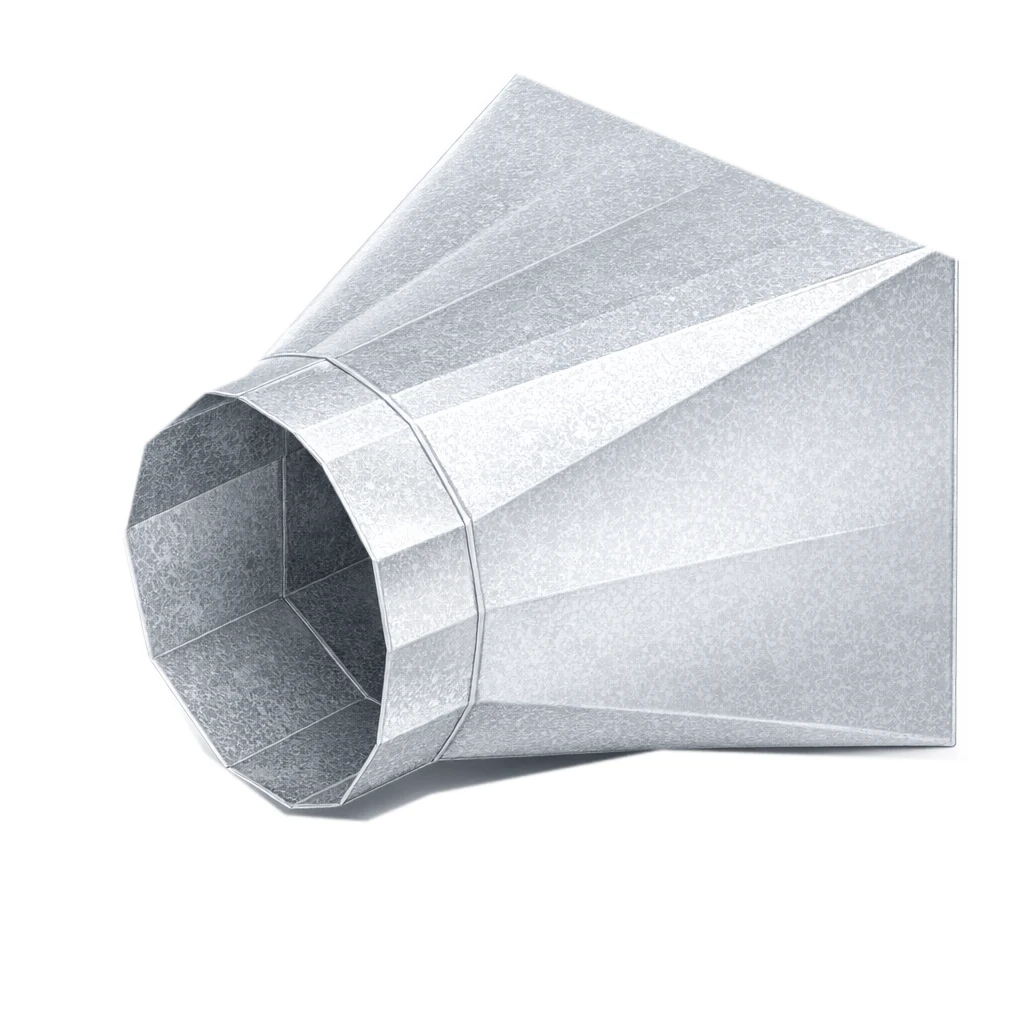
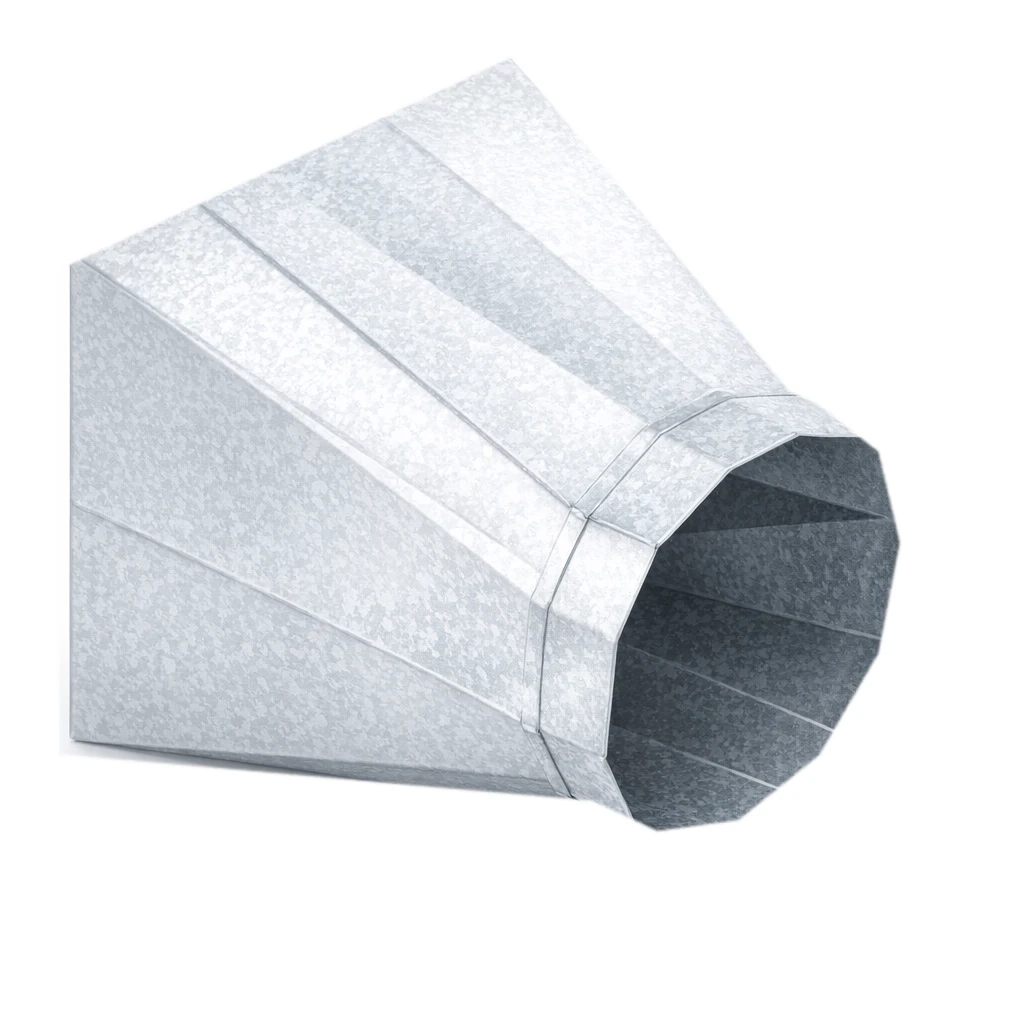
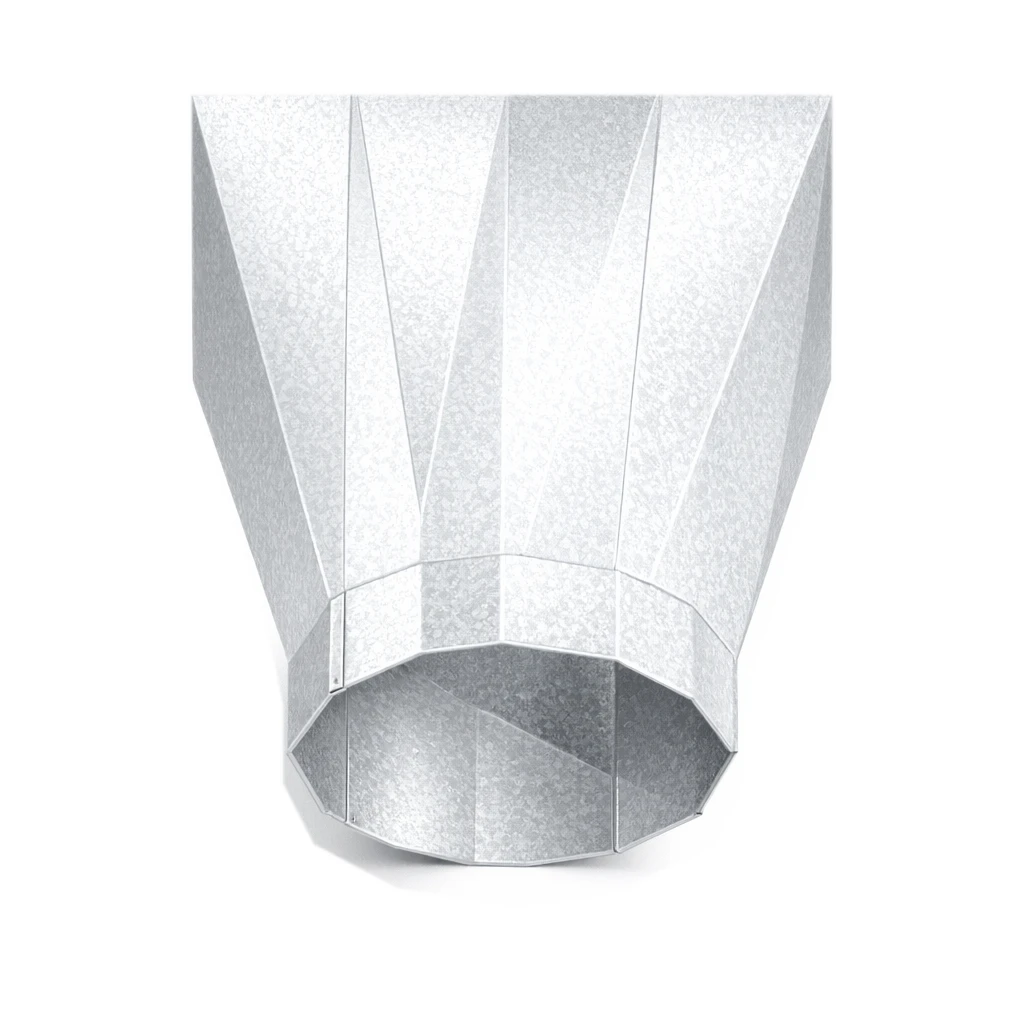
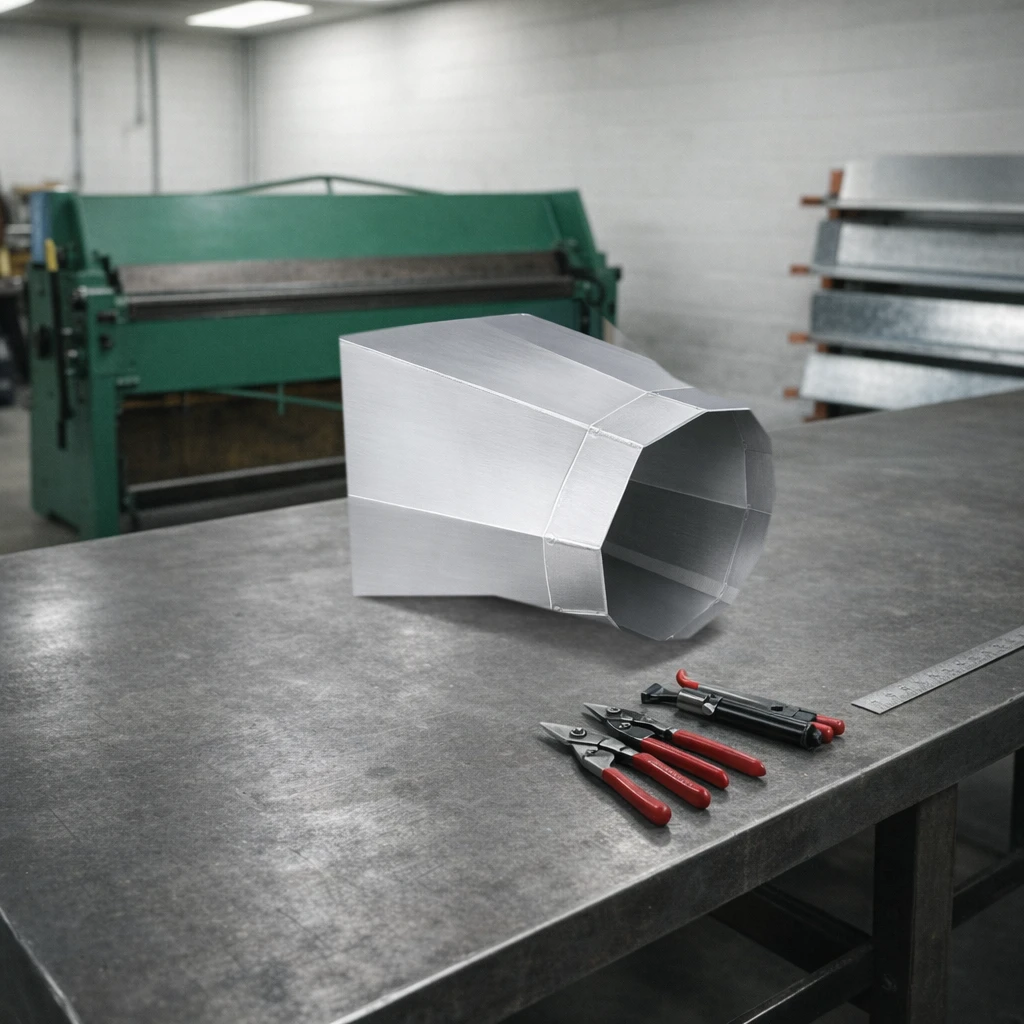
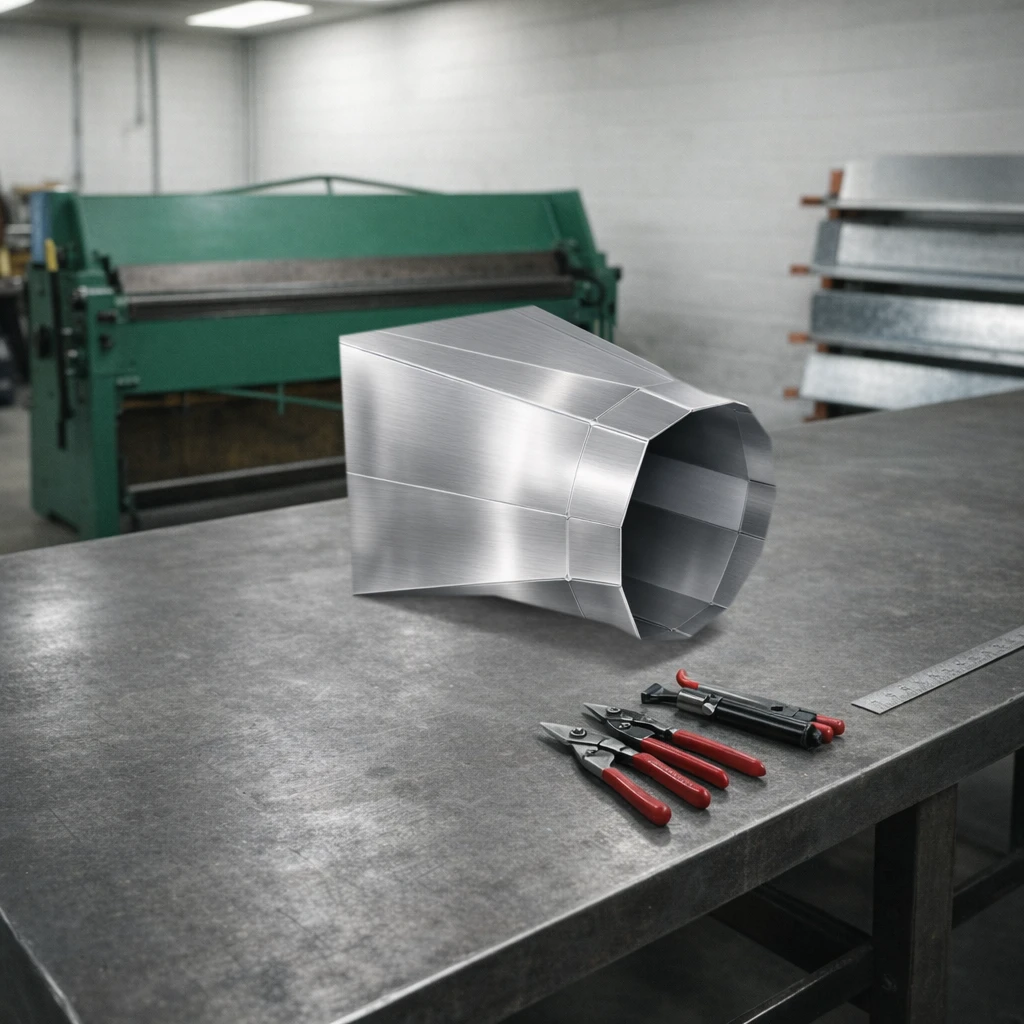
Specifications
- Inlet Width: 2" to 48"
- Inlet Dimension: 2" to 48"
- Outlet Diameter: 2" to 48"
- Length: 10" to 36"
- Materials: Galvanized Steel, Aluminum, Stainless Steel
- Gauges: 26, 24, 22, 20
- Connections: Raw, Slip, Drive, TDC, Flanged
Ships in 1 business day. Every fitting is cut, formed and inspected in our Pittsburgh shop and leaves the next business day — not the one to three weeks most custom shops quote.
Popular Square to Round Transition Sizes & Prices
Twelve-inch length, slip-and-drive rectangular end, slip round collar. Every row is its own orderable page; the full list of 984 sizes adds aluminum, stainless and 18" lengths for each.
| Rectangular inlet | Round outlet | Material | Gauge | Price | Order |
|---|---|---|---|---|---|
| 8" x 8" | 6" | Galvanized | 24 ga | $68.72 | Order this size |
| 10" x 8" | 6" | Galvanized | 24 ga | $69.43 | Order this size |
| 10" x 10" | 8" | Galvanized | 24 ga | $71.23 | Order this size |
| 12" x 8" | 7" | Galvanized | 24 ga | $70.68 | Order this size |
| 12" x 10" | 8" | Galvanized | 24 ga | $71.93 | Order this size |
| 12" x 10" | 8" | Aluminum | 24 ga | $110.93 | Order this size |
| 12" x 10" | 8" | Stainless | 24 ga | $149.93 | Order this size |
| 12" x 12" | 9" | Galvanized | 24 ga | $73.19 | Order this size |
| 14" x 10" | 8" | Galvanized | 24 ga | $72.63 | Order this size |
| 14" x 12" | 10" | Galvanized | 24 ga | $74.44 | Order this size |
| 16" x 10" | 9" | Galvanized | 24 ga | $73.89 | Order this size |
| 16" x 12" | 10" | Galvanized | 22 ga | $81.64 | Order this size |
| 16" x 12" | 10" | Aluminum | 22 ga | $130.39 | Order this size |
| 16" x 12" | 10" | Stainless | 22 ga | $179.14 | Order this size |
| 16" x 16" | 12" | Galvanized | 22 ga | $84.15 | Order this size |
| 18" x 12" | 10" | Galvanized | 22 ga | $82.34 | Order this size |
| 20" x 12" | 12" | Galvanized | 22 ga | $84.15 | Order this size |
| 20" x 14" | 12" | Galvanized | 22 ga | $84.85 | Order this size |
| 20" x 20" | 14" | Galvanized | 22 ga | $88.06 | Order this size |
| 24" x 14" | 14" | Galvanized | 22 ga | $87.36 | Order this size |
| 24" x 16" | 16" | Galvanized | 22 ga | $89.16 | Order this size |
| 24" x 24" | 18" | Galvanized | 20 ga | $102.82 | Order this size |
| 30" x 16" | 16" | Galvanized | 20 ga | $101.02 | Order this size |
| 30" x 24" | 20" | Galvanized | 20 ga | $106.03 | Order this size |
Custom Square to Round Duct Transitions: The Complete Guide
A square to round duct transition, also called a rectangular-to-round adapter, a round-to-square transition, a transition box, a duct conversion or simply a sq-to-rd, is the fitting that turns a rectangular opening into a round one over a short length of tapered sheet metal. It is the single most common fitting a duct job needs that the supply house does not stock in the size the job needs. Rectangular trunk and plenum sizes come in two-inch steps on two dimensions, round pipe comes in one-inch steps, and the combination on any given job is one of hundreds. That is why customers tell us we are one of the very few shops that will build a square to round to the exact size they type in, and why this page exists.
Everything below is what we tell customers on the phone: what the fitting is, why the pattern is hard to make by hand, how to pick the round diameter, how long the taper should be, which gauge and material to specify, how the ends connect, and how to measure the opening you have. If you already know your numbers, the designer above prices them instantly and the popular-sizes table links to a page for each common size.
What a square to round transition actually is
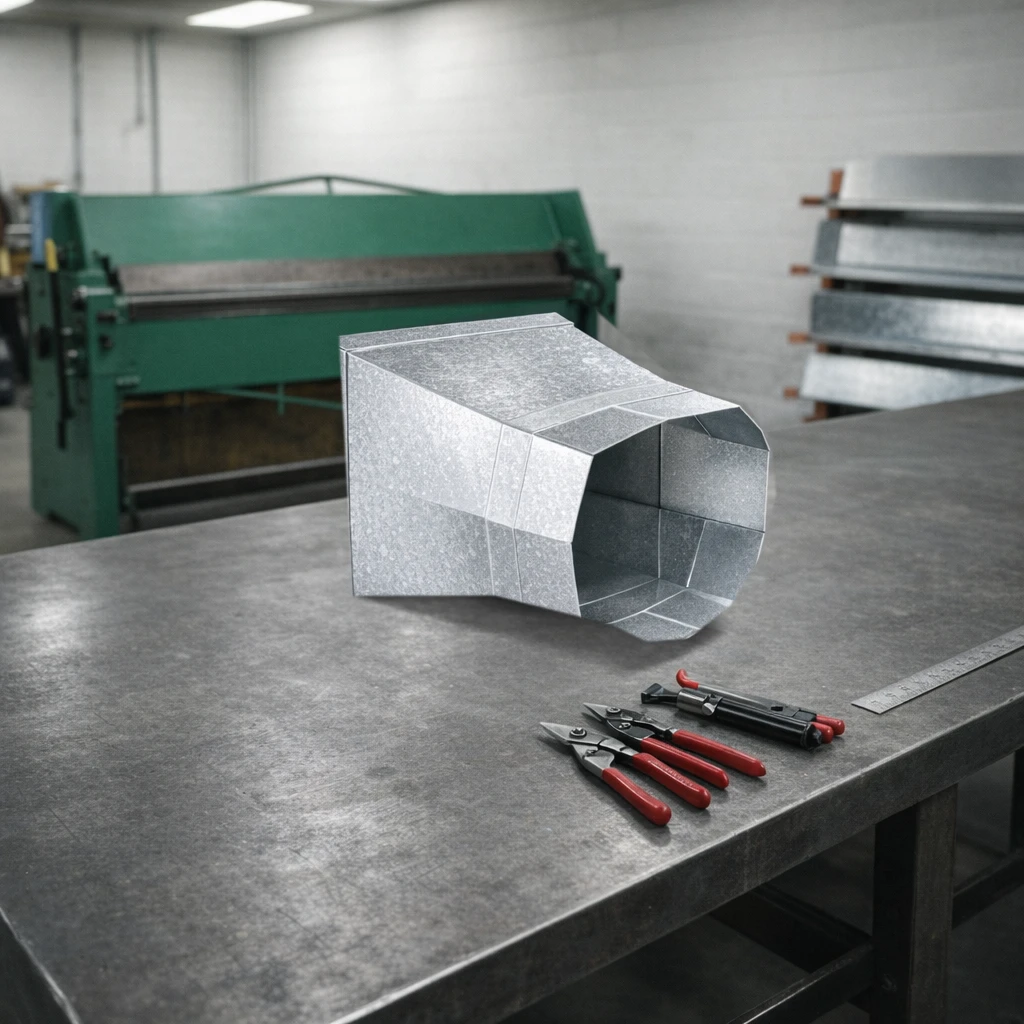
Geometrically the fitting is a rectangle at one end and a circle at the other, joined by a surface made of four flat triangles and four conical corner gores. The flat triangles run from each straight side of the rectangle to a point on the circle; the corner gores are pieces of a cone that wrap the round end around each corner of the rectangle. When the piece is laid out flat, those triangles and gores are developed by triangulation, the same method every sheet-metal apprentice learns in the pattern-drafting course and almost nobody uses again, because it takes a drawing board, a set of trammels and most of an afternoon for one fitting. Our designer develops the flat pattern from the four dimensions you enter, cuts it to that pattern, and the shop forms and seams it. The result meets both openings square and true, with no field-cut notches and no caulk bridging a gap.
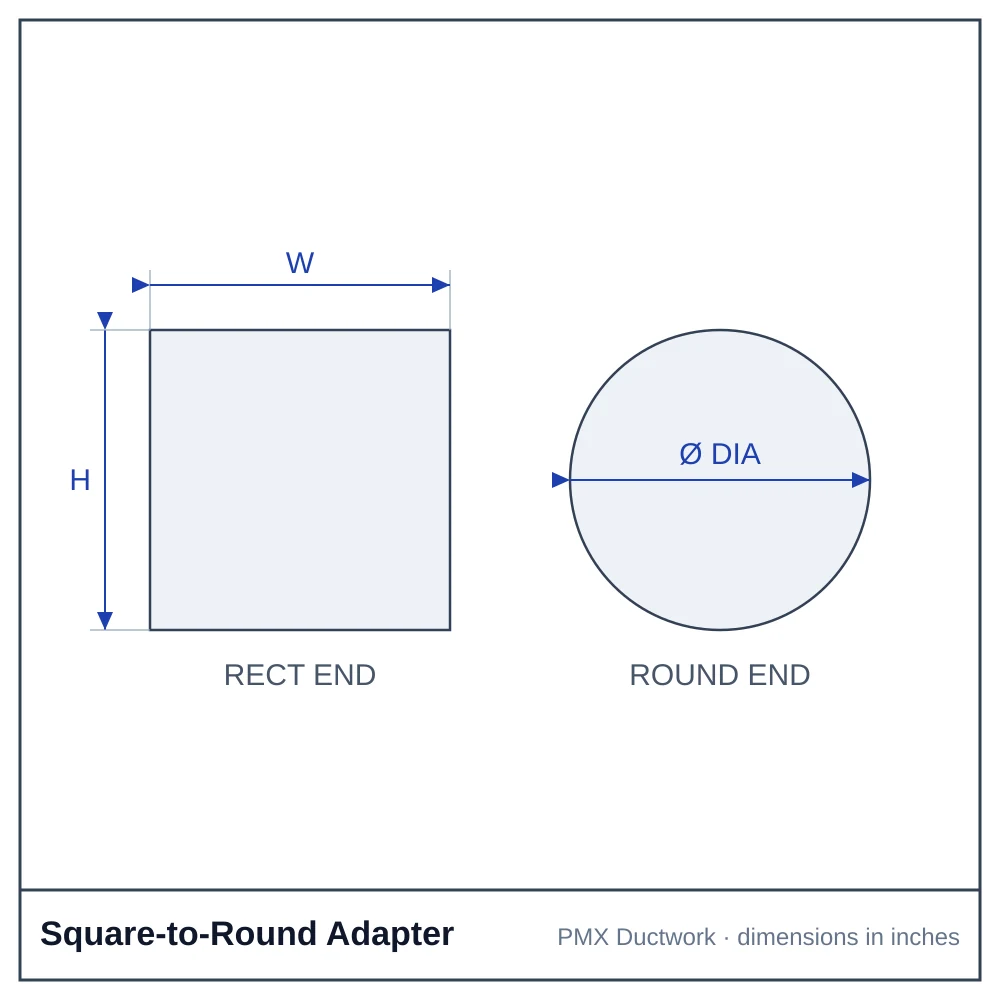
The four numbers that define the fitting are the rectangular inlet width, the rectangular inlet depth, the round outlet diameter, and the overall length from the rectangular face to the round face. The rectangular end is finished for slip-and-drive connection to rectangular duct or a plenum collar; the round end is a plain slip collar sized to fit inside standard round pipe or a flex-duct sleeve. Air can flow either direction through the fitting. A "round to rectangular" transition on a drawing is the same part specified from the other end, so enter the rectangle as the inlet and the round as the outlet regardless of which way the air goes.
Where square to rounds are used
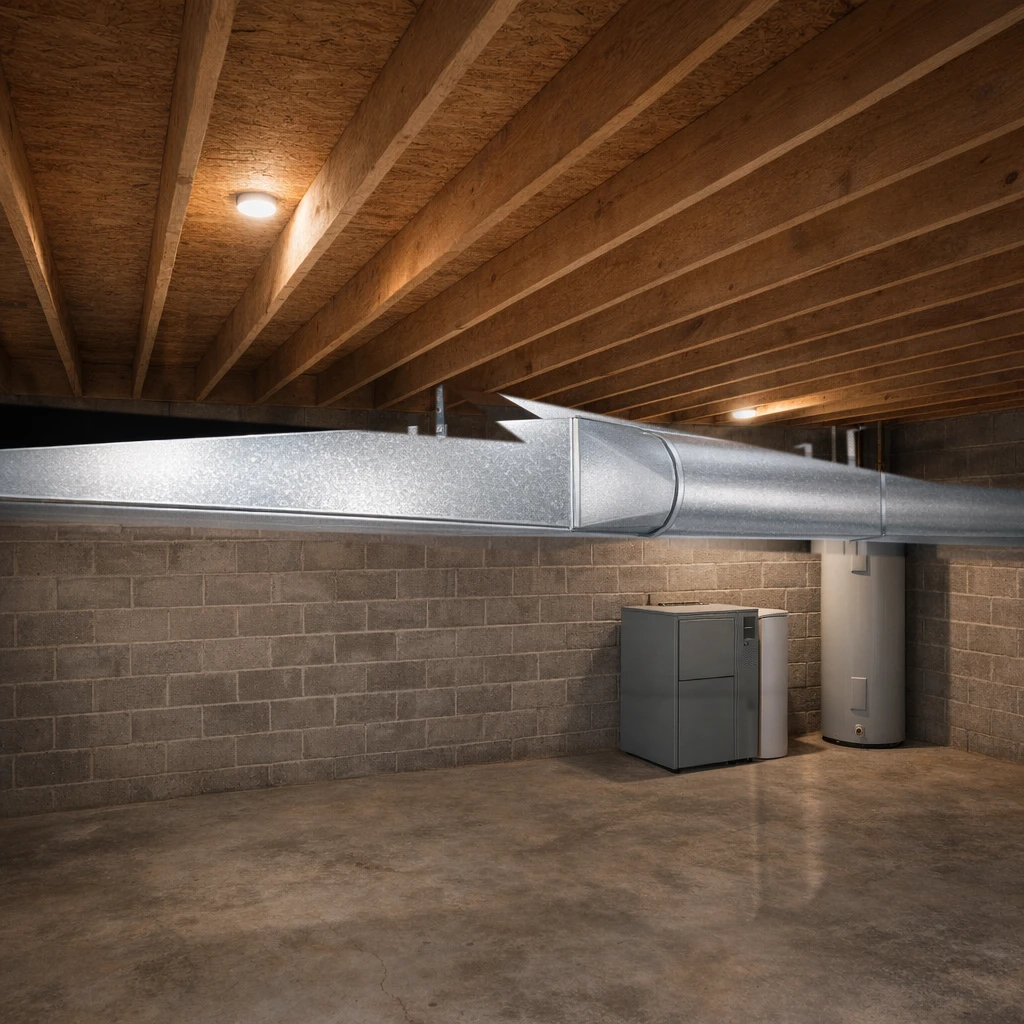
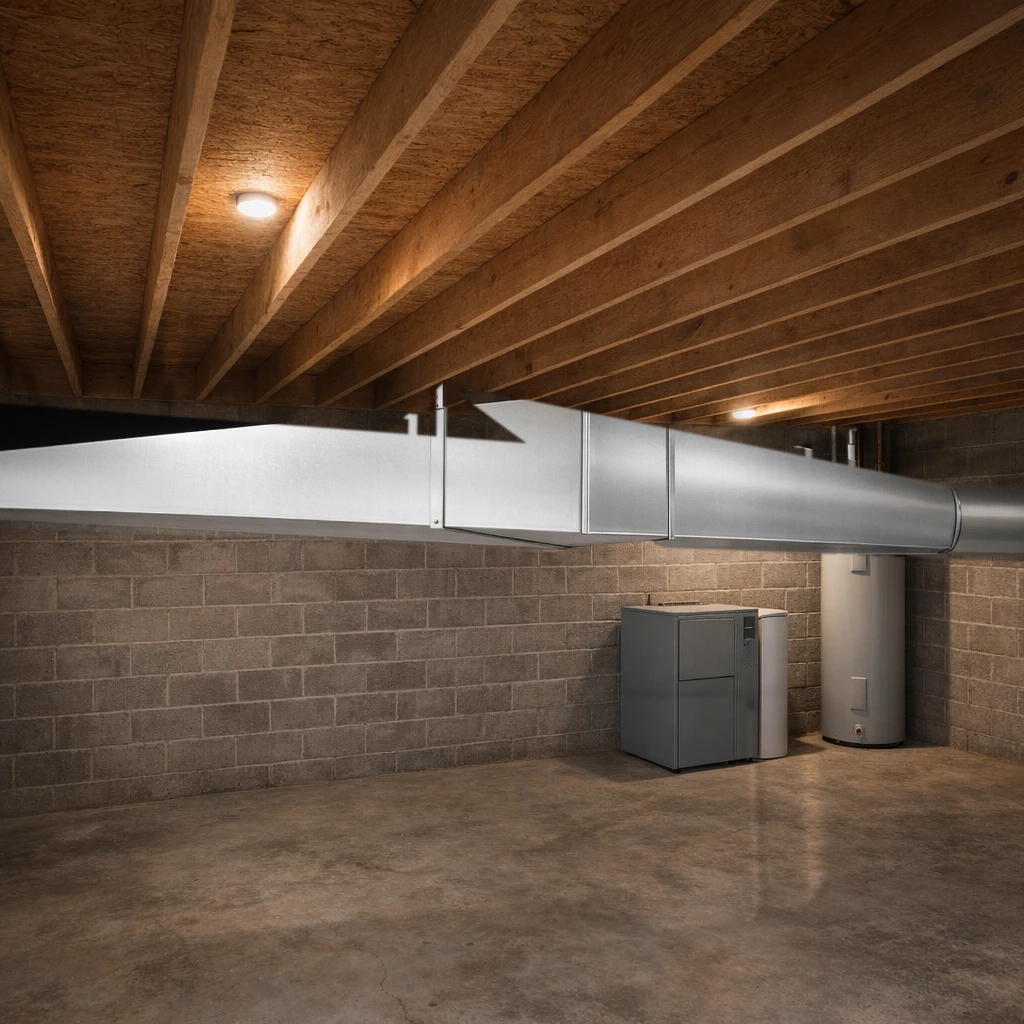
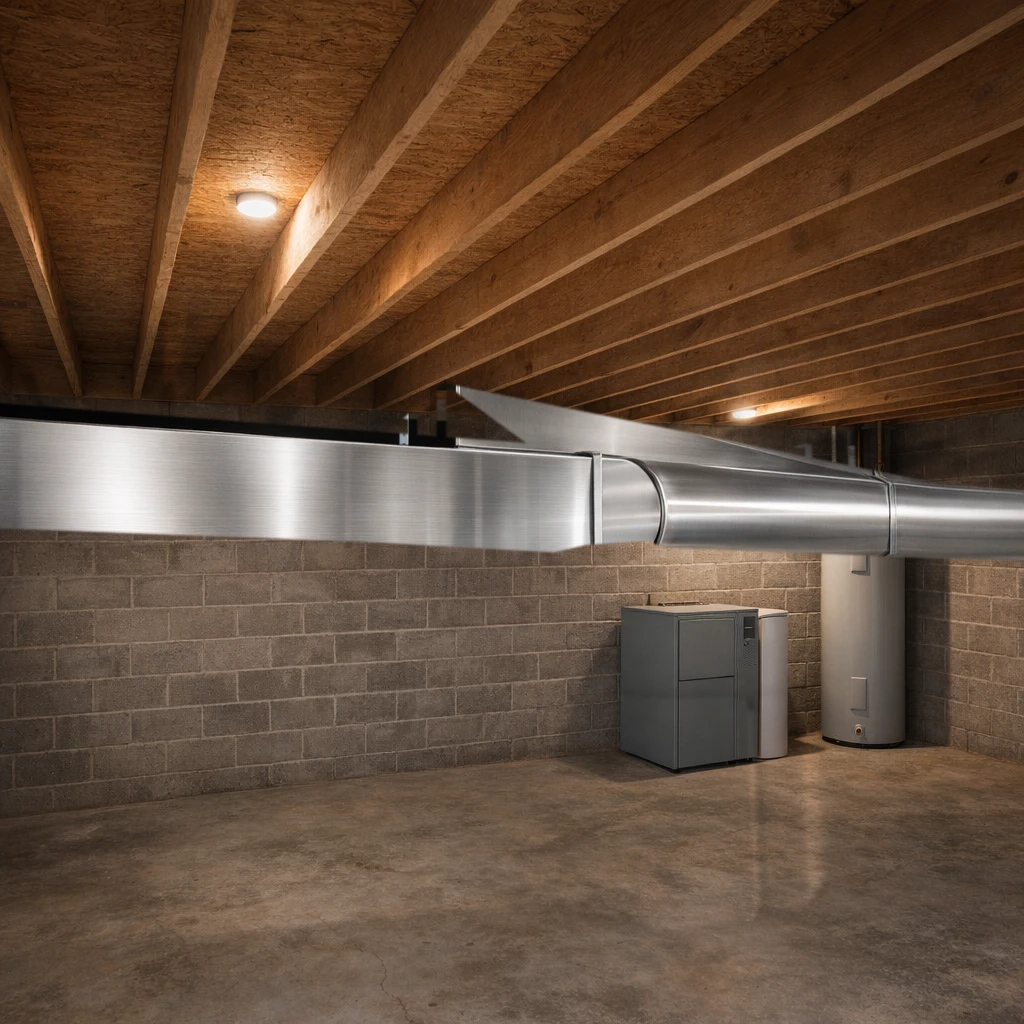
- Rectangular trunk to round branch. The most common residential case: a 20" x 8" or 24" x 8" extended plenum trunk feeding 6", 7" or 8" round branch runs. A square to round on a rectangular collar gives a far smoother takeoff than a stamped saddle tap, especially on the last few branches where the trunk has already reduced.
- Furnace or air-handler plenum to round supply. When the whole supply system is round pipe or spiral duct but the equipment outlet is rectangular, one large square to round (typically 20" x 20" to 16" or 24" x 24" to 18") converts the plenum to the trunk pipe.
- Return air. A rectangular return grille box or filter rack converting to a round return duct. Sizing here is usually looser and larger, since return velocity should stay low.
- Exhaust hoods and fans. Kitchen hoods, fume hoods, paint booths and dust-collection hoods have rectangular collars; the fan or the run is round. Stainless or heavier-gauge galvanized is normal here.
- Register and diffuser boxes. A rectangular ceiling diffuser neck or a floor register box fed by round pipe. For the smaller sizes a factory register boot is usually the right part; for anything over about 12" x 12" or any nonstandard box a square to round is what fits.
- Commercial rectangular to spiral. Rectangular duct out of the mechanical room converting to round spiral for the long runs, where round duct is cheaper per foot and leaks less.
Sizing the round outlet: match the area
The rule that resolves nearly every square to round question is to keep the free area the same on both ends, so the air does not have to speed up or slow down through the fitting. The equal-area round diameter is
D = 2 × √( W × H ÷ π )
where W and H are the rectangular inlet dimensions in inches. Some quick reference values, all rounded to the nearest pipe size we stock the collar for:
| Rectangular inlet | Free area | Equal-area diameter | Usual round outlet |
|---|---|---|---|
| 8" x 8" | 64 sq in | 9.0" | 8" or 9" |
| 10" x 8" | 80 sq in | 10.1" | 10" |
| 12" x 8" | 96 sq in | 11.1" | 10" or 12" |
| 12" x 10" | 120 sq in | 12.4" | 12" |
| 12" x 12" | 144 sq in | 13.5" | 14" |
| 14" x 10" | 140 sq in | 13.4" | 12" or 14" |
| 16" x 12" | 192 sq in | 15.6" | 16" |
| 20" x 12" | 240 sq in | 17.5" | 16" or 18" |
| 20" x 20" | 400 sq in | 22.6" | 20" or 22" |
| 24" x 24" | 576 sq in | 27.1" | 26" or 28" |
You will notice the equal-area round is usually smaller than the long side of the rectangle and larger than the short side. That is normal. A round duct carries the same air in less perimeter, which is exactly why long runs are cheaper in round. When the round end is a branch takeoff rather than the whole trunk, the round is sized for the branch airflow, not for the trunk area, and the transition is simply the collar that makes that branch pipe fit a rectangular opening; a 20" x 8" trunk feeding a 7" branch is a perfectly normal square to round even though the areas are nowhere near equal.
The calculator at the top of this page does the arithmetic, tells you the nearest standard round size, and, if you enter the CFM, shows the velocity in each end so you can see whether the round is too small. As a rule of thumb keep residential supply branches under about 900 feet per minute and trunks under about 1,000; commercial low-pressure systems run higher.
How long the taper should be
A square to round converts shape and usually converts size, and any change in size should happen gradually or the air separates from the wall and the fitting adds static pressure and noise. The guideline for a contracting transition is that no side should slope more than about 15 degrees from the duct axis (a 30 degree included angle); for an expanding transition, where the air is slowing down, 10 degrees per side is better because the flow separates more easily on the way out. Convert that to a length and the minimum for a 15 degree taper is
Lmin = ( larger rectangular side − round diameter ) ÷ 2 × 3.7
So a 12" x 10" to 8" round needs at least 7.5"; a 20" x 12" to 12" round needs about 15"; a 24" x 24" to 16" needs about 15". Twelve inches is our default length because it satisfies the rule for nearly every residential size, and the 18" length is published for the larger commercial inlets. Where space is tight, a shorter, steeper fitting still works; it just costs a little more static pressure. Where you have room, longer is always quieter. The calculator flags a length shorter than the 15 degree minimum so you can decide with the number in front of you.
Gauge
Sheet-metal gauge for low-pressure duct is set by the largest dimension of the fitting. The size pages on this site default to the gauge that a two-inch-water-column residential or light-commercial system would use for the rectangular inlet: 26 gauge for inlets up to about 14" on the long side, 24 gauge to about 26", 22 gauge to about 40", and 20 gauge above that. Because the rectangular end is the largest part of the fitting and the corners are stiffened by the gore seams, a square to round is stiffer than a straight duct of the same gauge and size, so these defaults are conservative. Step up one gauge for kitchen exhaust, dust collection, outdoor or rooftop work, anywhere the fitting will be walked on or leaned on, or any medium-pressure system. Every size page lets you change gauge in the designer and the price updates on the spot.
Galvanized, aluminum or stainless
Galvanized steel is the standard for heating and cooling duct and is what nine out of ten square to rounds are made of. It is the least expensive, it takes duct sealant and tape well, and it is what the rest of the system is made of. Aluminum weighs about a third as much, does not rust, and is specified for pool and spa air handlers, coastal installations, some laboratory exhaust, and anywhere a fitting has to be lifted into place by hand. It is softer, so we hold the same gauge number, which in aluminum is a slightly thicker sheet. Stainless steel is the material for commercial kitchen grease exhaust, chemical and process exhaust, washdown environments, and any fitting that will be exposed and must stay bright. Each material is priced live; the popular-sizes table above shows all three for two common sizes so you can see the difference.
How the ends connect
The rectangular end is finished with a slip-and-drive edge: the two long sides receive an S-cleat and the two short sides receive a drive cleat, exactly as on rectangular duct, so the fitting joins a plenum collar or a trunk section the same way any rectangular joint does. The round end is a plain slip collar sized to fit inside the round pipe or flex-duct sleeve. Install with the round collar inside the pipe (male into female, in the direction of airflow where possible), pull the flex or pipe over the collar, screw with three sheet-metal screws, and seal the joint with mastic or UL 181 foil tape. The gore seams on the corners of the fitting are made in the shop; the only field joints are the two ends. If your job calls for TDC/TDF flanges or a raw edge on the rectangular end, mention it in the order notes and we will build to it.
How to measure the opening you have
- Rectangular end: measure the inside width and inside depth of the duct, plenum collar or hood opening the fitting will slip onto. Give the fitting those dimensions; the slip-and-drive edge adds the connection allowance. If you are joining to an existing rectangular duct, its nominal size (the number stamped or written on it) is the inside dimension.
- Round end: give the nominal pipe or flex size, for example 8". Our collar is built to fit inside 8" pipe. If you are connecting to an equipment collar rather than pipe, measure its outside diameter and tell us; the fitting can be built to slip over it.
- Length: measure the space available between the two connections and subtract the overlap at each end. If the length is not critical, use 12" or whatever the calculator gives as the 15 degree minimum, whichever is greater.
- Orientation: a centered round outlet does not care which way it is turned. If your round pipe has to be flush with one wall of the rectangular opening, that is an offset square to round; call us with which edge is flush.
Why field-made square to rounds go wrong
Every installer has cut the corners off a piece of rectangular duct, folded the flaps in and clamped a round collar into the hole. It gets air from one place to the other. It also leaks at every fold, it creates a step that the air has to jump, and the round collar is rarely square to the duct axis, so the pipe comes off at an angle and the next joint fights it. A developed transition has none of those problems: the round collar is concentric and perpendicular by construction, the taper is continuous so there is no step, and the only joints are the ones at the ends. On a supply trunk the difference is measurable in static pressure and audible in the register. On a kitchen or process exhaust, where the duct must be sealed grease-tight or airtight, the field version is not acceptable at all.
Square to round versus a register boot, a reducer, or a transition
The names get used loosely, so here is how we use them. A register boot is a rectangular box with a round collar on one side or the end, meant to sit behind a register; the rectangle is the register size and the round is a branch pipe. It is a box, not a taper, and it is the right part for a 4" x 10" or 4" x 12" floor register. A reducer changes size but not shape: rectangular to smaller rectangular, or round to smaller round. A transition in our catalog is rectangular to a different rectangular size, tapered on one or more sides. A square to round is the only one of the four that changes the cross-section from four sides to a circle, and it is the one this page is about.
Ordering, price and turnaround
Set the four dimensions in the designer, choose material and gauge, and the price shown is the price you pay; there is no quote step for standard configurations. Each fitting is made to order in our Pittsburgh shop from full sheets, so an unusual size costs the same as a common one of the same amount of metal, and quantity does not change the unit price the way it does for stamped fittings. Add the fitting to the cart with the rest of the job, or order any of the 984 published sizes from its own page. For offset outlets, TDC flanges, heavier gauges than the designer offers, or a takeoff of a drawing, call 412.725.2744 or email sales@pmxductwork.com with the dimensions and we will price it the same day we read it.
Read more
- Square to round transitions: sizing and fabrication: the area-matching and taper rules in more depth, with the centered-versus-offset outlet discussion.
- Custom square-to-round duct fittings, made to order: what to specify and where the fitting shows up on real jobs.
- Duct transitions guide and rectangular versus round duct: when to convert a system to round in the first place.
- Every published square to round size with its price.
Frequently Asked Questions
When do I need a square-to-round transition?
Any time a rectangular duct, plenum or equipment opening has to connect to round pipe or flex duct: a rectangular trunk feeding a round branch, a furnace or air-handler plenum feeding round supply pipe, a rectangular exhaust hood collar going to a round fan inlet, or a rectangular register box on a round run. The same fitting installed the other way is a round-to-rectangular transition.
What size round outlet should I use for my rectangular duct?
Match the free area. The equal-area round diameter is 2 × √(width × depth ÷ π). A 12" x 10" rectangle has 120 square inches, which is a 12.4" round, so a 12" outlet keeps the air velocity about the same. Use the calculator on this page; it computes the equal-area diameter and the velocity at any CFM.
How long should a square-to-round transition be?
Long enough that no side slopes more than about 15 degrees. Divide the difference between the largest rectangular dimension and the round diameter by two, then multiply by 3.7 to get the minimum length for a 15 degree taper. A 20" x 12" to 12" round needs about 15"; a 12" x 10" to 8" round is fine at the 10" minimum. Our minimum length is 10 inches. Twelve inches covers most residential sizes, which is why it is the default.
Can the round end be offset from center?
The designer on this page builds a centered round outlet, which is what almost every installation needs. If your round pipe has to land against one side of the rectangular opening, call 412.725.2744 or email sales@pmxductwork.com with the inlet size, outlet diameter, length and which edge the round should be flush with, and we will quote it as a custom piece.
What gauge should a square-to-round be?
For low-pressure residential and light-commercial supply duct: 26 gauge up to about 14" on the long side, 24 gauge to about 26", 22 gauge to about 40", 20 gauge above that. Those are the gauges the size pages on this site default to. Kitchen exhaust, dust collection and outdoor work usually go one gauge heavier.
Galvanized, aluminum or stainless: which material?
Galvanized steel for ordinary heating and cooling duct. Aluminum where weight matters or where the fitting is in a corrosive but non-food environment such as a pool room or coastal air handler. Stainless steel for kitchen grease exhaust, laboratory and process exhaust, washdown areas and anywhere the fitting will be visible and must stay bright. All three are priced live in the designer.
Do you make round-to-square and rectangular-to-round adapters too?
Yes. Square to round, rectangular to round, round to rectangular, round to square, square-to-round adapter and transition box are all names for the same fitting. Air can go through it in either direction; you specify the rectangular end and the round end and we build it.
Can I get a size that is not in your published list?
Yes. The 984 published sizes are the common ones. The designer accepts any rectangular width and depth, any round diameter and any length of 10 inches or more in quarter-inch steps, prices it instantly, and lets you add it to the cart. Every fitting is made to order, so an odd size costs the same as a common one of the same amount of metal.