Custom Straight Rectangular Duct, Made to Order in Any Size
Rectangular sheet metal trunk and branch duct fabricated to your exact width, depth and length in galvanized, aluminum or stainless. Set the size below, watch it build in 3D, and see the price change as you type.
Looking for a specific size? See all 572 straight rectangular duct sizes we publish, with prices. Each size has its own page you can order from, in galvanized, aluminum and stainless.
Rectangular Duct Sizing Calculator: CFM to Size
Enter the airflow, the velocity you want to stay under, the friction rate you are designing to, and the depth the duct has to fit. We size the duct both ways, by velocity and by friction, recommend the larger, and show the velocity and friction the finished duct will actually run at. Then load it straight into the designer for a live price.
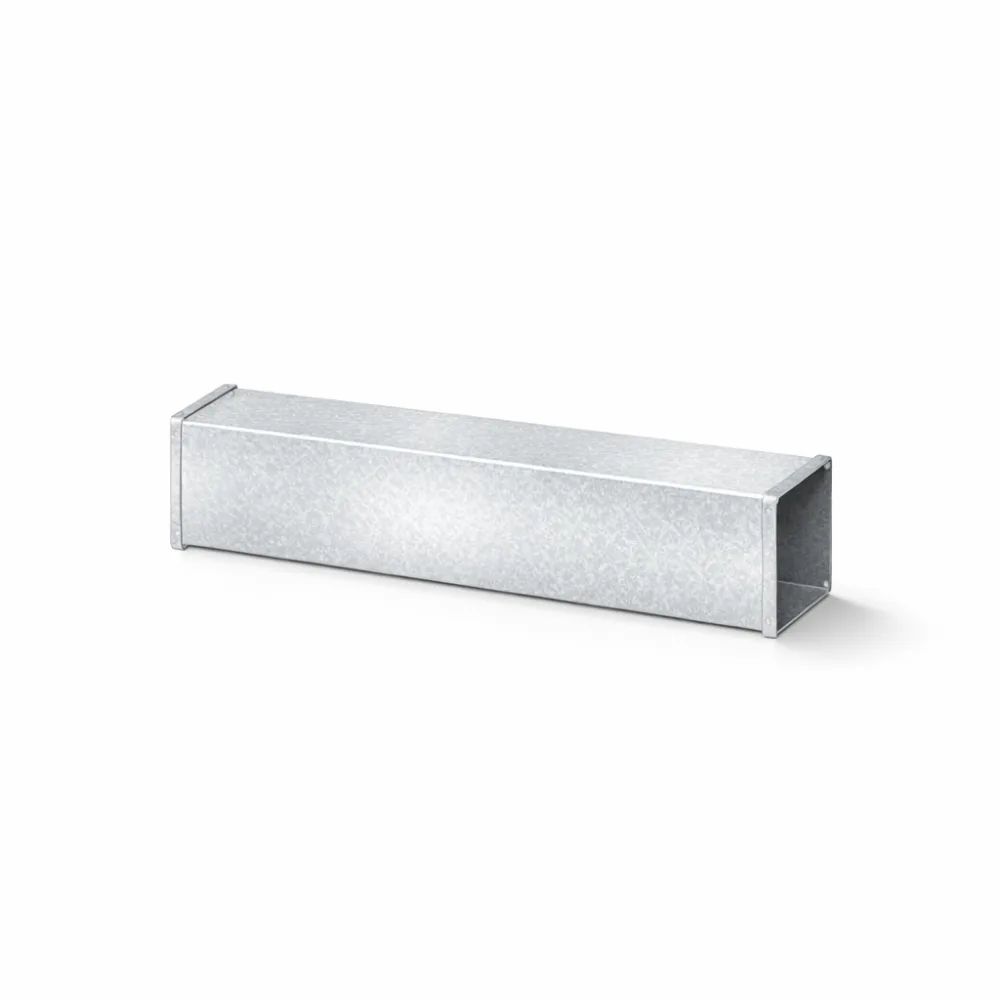
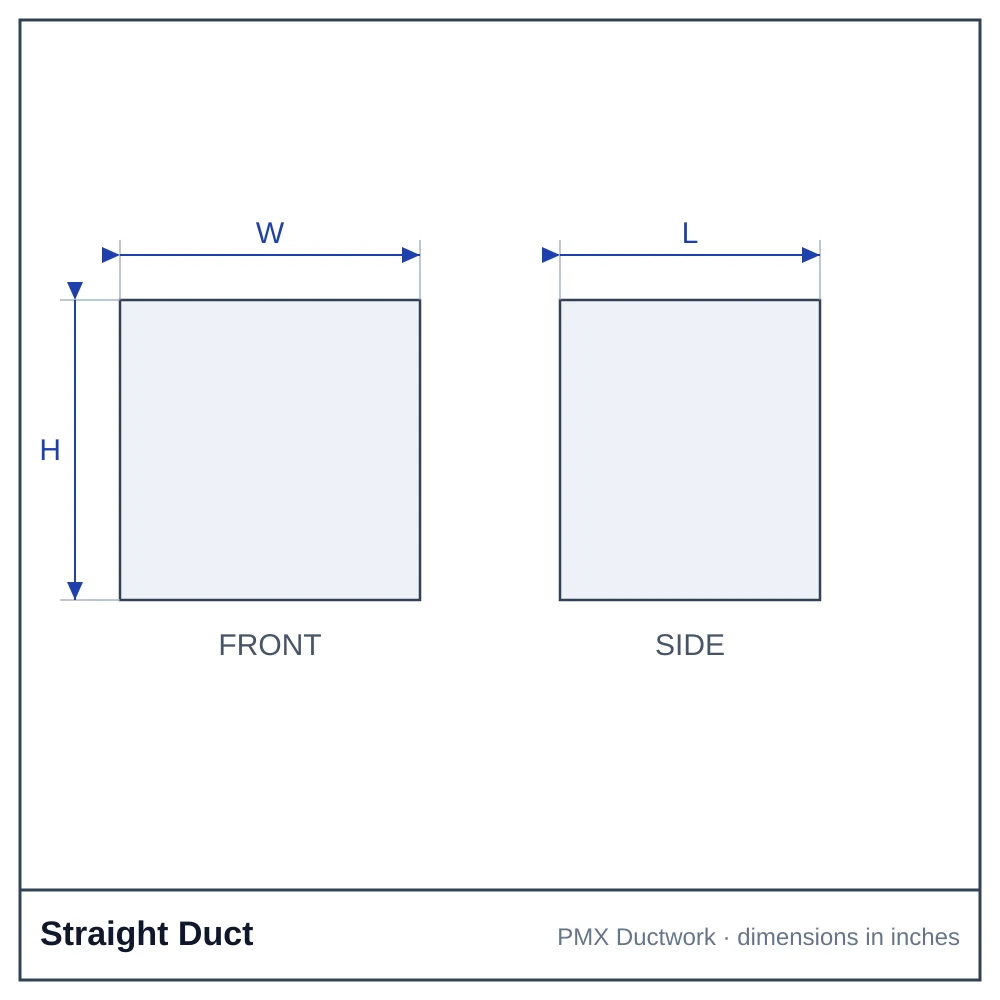
Specifications
- Width: 2" to 48"
- Depth: 2" to 48"
- Length: 6" to 96" (8 ft)
- Materials: Galvanized Steel, Aluminum, Stainless Steel
- Gauges: 26, 24, 22, 20
- Connections: Raw, Slip, Drive, TDC, Flanged
Ships in 1 business day. Every fitting is cut, formed and inspected in our Pittsburgh shop and leaves the next business day — not the one to three weeks most custom shops quote.
Popular Straight Rectangular Duct Sizes & Prices
Slip-and-drive on both ends, gauge set by the long side. Every row is its own orderable page; the full list of 572 sizes adds aluminum, stainless and 60" lengths for each.
| Width x depth | Length | Material | Gauge | Price | Order |
|---|---|---|---|---|---|
| 6" x 6" | 48" | Galvanized | 26 ga | $61.32 | Order this size |
| 8" x 6" | 48" | Galvanized | 26 ga | $64.07 | Order this size |
| 8" x 8" | 48" | Galvanized | 24 ga | $71.36 | Order this size |
| 10" x 8" | 48" | Galvanized | 24 ga | $74.11 | Order this size |
| 12" x 8" | 48" | Galvanized | 24 ga | $76.86 | Order this size |
| 12" x 10" | 48" | Galvanized | 24 ga | $79.60 | Order this size |
| 12" x 12" | 48" | Galvanized | 24 ga | $82.35 | Order this size |
| 14" x 8" | 48" | Galvanized | 24 ga | $79.60 | Order this size |
| 14" x 10" | 48" | Galvanized | 24 ga | $82.35 | Order this size |
| 16" x 10" | 48" | Galvanized | 24 ga | $87.26 | Order this size |
| 16" x 12" | 48" | Galvanized | 22 ga | $99.76 | Order this size |
| 18" x 12" | 48" | Galvanized | 22 ga | $105.21 | Order this size |
| 20" x 12" | 48" | Galvanized | 22 ga | $110.66 | Order this size |
| 20" x 14" | 48" | Galvanized | 22 ga | $116.12 | Order this size |
| 24" x 12" | 48" | Galvanized | 22 ga | $121.57 | Order this size |
| 24" x 18" | 48" | Galvanized | 22 ga | $137.93 | Order this size |
| 30" x 18" | 48" | Galvanized | 20 ga | $173.79 | Order this size |
| 36" x 24" | 48" | Galvanized | 20 ga | $211.39 | Order this size |
| 12" x 10" | 60" | Galvanized | 24 ga | $90.94 | Order this size |
| 20" x 12" | 60" | Galvanized | 22 ga | $132.48 | Order this size |
| 12" x 10" | 48" | Aluminum | 24 ga | $118.60 | Order this size |
| 12" x 10" | 48" | Stainless | 24 ga | $157.60 | Order this size |
| 20" x 12" | 48" | Aluminum | 22 ga | $175.66 | Order this size |
| 20" x 12" | 48" | Stainless | 22 ga | $240.66 | Order this size |
Custom Straight Rectangular Duct: The Complete Guide
Straight rectangular duct is the part of an HVAC system nobody thinks about until the size they need is not on the shelf. Supply houses stock a handful of trunk sizes in a handful of lengths, and everything else is either "we can order it" or a field-made section that never quite fits. Every straight section we build is cut and formed to the width, depth and length you type into the designer above, in the gauge and material you pick, with the connection you want on each end. That is what this page is about: what a rectangular duct section is, how to size it from airflow, which gauge and connection to specify, how to measure for it, and how to order it without a quote step.
If you already have your numbers, the designer prices them as you type and the popular-sizes table links to a page for each common size. If you are sizing from CFM, the calculator above does the velocity and friction math and loads the answer into the designer. Everything below is the reasoning behind those numbers.
What a straight rectangular duct section is
A rectangular duct section is a four-sided sheet metal tube, made from one or two pieces of flat sheet, bent square at the corners and closed along its length with a Pittsburgh lock: a folded seam that is hammered closed and needs no screws, rivets or solder. The ends are finished for whatever joint the job uses. On a slip-and-drive section, the long sides get a flat edge that slides into an S-cleat and the short sides get a folded edge that a drive cleat hammers over. On a TDC section, all four edges are rolled into a flange. On a raw section, the ends are left square for a field connection.
The three numbers that define the section are the inside width, the inside depth and the overall length. Width and depth are the nominal duct size, the same numbers written on a plan or stamped on existing duct. Length is the length of the sheet metal; the connection allowance is added by the shop, so a 48" section with slip-and-drive ends makes a 48" run once the cleats are on. Nothing is stamped, nothing is a stock casting, so any dimension in quarter-inch steps costs the same as the round number next to it.
Where rectangular duct is used
- Supply trunks. The extended-plenum trunk out of a furnace or air handler is the most common rectangular duct on a residential job: 20" x 8", 24" x 8", 20" x 10" and similar wide-and-shallow sizes that fit between joists, with round branches taken off the sides.
- Return trunks. Return duct runs larger and slower than supply, so 24" x 12", 24" x 14" and 30" x 12" rectangular returns are ordinary even on a house that runs round supply pipe.
- Joist and stud spaces. Anywhere the duct has to live inside framing, rectangular wins. A 14" x 8" section fits a joist bay where an equivalent 11" round would not.
- Commercial low-pressure and medium-pressure mains. Rectangular mains up to 48" wide, in 22 or 20 gauge with TDC joints, are the standard commercial duct above ceilings, along walls and in mechanical rooms.
- Exhaust and process runs. Kitchen hoods, welding exhaust, paint booths and dust collection often need a short rectangular section between a rectangular hood collar and the first transition or elbow, usually in heavier gauge or stainless.
- Exposed and architectural duct. Rectangular duct in a loft or retail ceiling is easier to run parallel to walls and beams and to keep visually straight than round.
Sizing rectangular duct from CFM
Duct is sized by two limits, and the correct size is whichever is larger. The first is velocity: air moving too fast through a duct is noisy and pushes against the fan. The second is friction: the pressure the fan loses per foot of duct, which adds up over a long run and is what the system's static pressure budget actually pays for. Residential design normally aims for supply trunks around 900 feet per minute and branches around 600 to 700, returns lower still, with a friction rate between 0.06 and 0.10 inches of water per 100 feet. Commercial low-pressure systems run higher velocities, up to about 1,500 fpm in mains, and friction rates near 0.10.
Sizing by velocity is arithmetic: the free area the duct needs, in square inches, is
A = CFM ÷ velocity × 144
so 800 CFM at 900 fpm needs 128 square inches, which is a 16" x 8" duct. Sizing by friction is the ductulator calculation. The round diameter that carries a given CFM at a given friction rate follows the duct friction relation used in Manual D and the ASHRAE friction chart, and a rectangle is then chosen whose equivalent diameter matches. The equivalent diameter of a rectangle is not the equal-area diameter; it is the diameter of the round duct with the same friction per foot at the same flow, and it is always a little smaller than equal area because a rectangle has more wall for the same area:
De = 1.30 × (W × H)0.625 ÷ (W + H)0.25
The calculator at the top of the page does both calculations, holds the depth you give it, and returns the width that satisfies both. Some reference values for a friction rate of 0.10 in. w.c. per 100 ft, sized to an 8" or 10" depth as a residential trunk usually is:
| Airflow | Round at 0.10 | Rectangle, 8" deep | Rectangle, 10" deep | Velocity in the 8" deep duct |
|---|---|---|---|---|
| 400 CFM | 10" | 12" x 8" | 10" x 10" | 600 fpm |
| 600 CFM | 12" | 14" x 8" | 12" x 10" | 770 fpm |
| 800 CFM | 13" | 18" x 8" | 14" x 10" | 800 fpm |
| 1,000 CFM | 14" | 22" x 8" | 18" x 10" | 820 fpm |
| 1,200 CFM | 15" | 26" x 8" | 20" x 10" | 830 fpm |
| 1,600 CFM | 17" | 34" x 8" | 26" x 10" | 850 fpm |
| 2,000 CFM | 18" | 40" x 8" | 30" x 10" | 900 fpm |
Two things stand out in that table. First, at residential friction rates the friction limit governs on the smaller ducts and velocity takes over as the airflow climbs, which is why the velocities creep up toward 900 fpm. Second, a shallow duct pays for its depth in width. A 1,200 CFM trunk that is 26" wide at 8" deep is 20" wide at 10" deep. If you can afford the depth, use it: the duct is cheaper, quieter and easier to hang, and the aspect ratio stays below 4 to 1, which is where the SMACNA reinforcement tables and the friction penalty both start to bite.
Aspect ratio
Aspect ratio is the long side divided by the short side. A square duct has the least perimeter for its area, so it carries air with the least metal and the least friction; as the duct gets flatter, both go up. A 2 to 1 ratio costs almost nothing. At 4 to 1 the duct uses about a quarter more sheet metal than a square of the same area and adds noticeable friction. Beyond about 5 to 1 the flat sides need reinforcement, the joints are harder to keep tight, and the duct drums. Where framing forces a very flat duct, it is usually better to split the airflow into two ducts or step down to a smaller trunk and take branches off sooner. The calculator flags any result over 4 to 1 so you can see the trade before you build it.
Gauge
Sheet metal gauge for low-pressure rectangular duct is set by the longest side of the section, because the wider a flat panel is, the more it flexes under pressure and the more it oil-cans when the fan starts. The published size pages on this site default to 26 gauge for duct up to 8" on the long side, 24 gauge to 20", 22 gauge to 36", and 20 gauge for 40" and 48" widths. Those defaults suit residential and light-commercial supply and return duct in the two-inch-water-column class. Step up one gauge for medium-pressure systems, for long unsupported spans, for exposed duct that will be leaned on or walked past by a forklift, for exhaust that runs warm, and for any duct longer than 60" between hangers. Every size page and the designer let you change the gauge, and the price updates on the spot.
Galvanized, aluminum or stainless
Galvanized steel is the standard for heating and cooling duct and is what the great majority of straight sections are made of. It is the least expensive, it takes mastic and foil tape well, and it is what the rest of the system is made of. Aluminum weighs about a third as much for the same gauge number, does not rust, and is specified for rooftop duct, pool and spa air handlers, coastal installations, some laboratory exhaust, and any section that has to be carried up a ladder by one person. Stainless steel is the material for commercial kitchen grease exhaust, chemical and process exhaust, washdown environments, and any exposed duct that must stay bright. Each material is priced live; the popular-sizes table shows all three for two common sizes so you can see the difference before you choose.
How the ends connect
Slip-and-drive is the default on every size page and the standard low-pressure residential joint. The long sides of the section get a flat edge that slides into an S-cleat shared with the next section; the short sides get a folded edge that a drive cleat is hammered over, locking the two sections together and pulling the S-cleats tight. It needs no screws in the joint, it goes together fast, and it seals well once the corners are mastic'd. TDC (transverse duct connector) rolls a flange on all four sides of the section; the two flanges are bolted or clipped together through corner pieces with a gasket between them and cleats along the flanges. It is stiffer, seals better, resists pressure better, and is the normal commercial joint on duct over about 18". A plain slip end is a flat edge for an S-cleat on all four sides where a drive is not wanted, a raw end is left square for a field-made connection or a flexible connector, and a flanged end is an angle-iron or bar flange for bolting to equipment. All five are in the designer, and you can mix them: slip-and-drive on one end and raw on the other is a common way to finish the last section at a plenum.
Length, hangers and joints
The designer builds any length from 6" to 96". The published sizes use 48" and 60" because those are the sections one or two people can hang and join without a lift, and because they let you land a joint at each hanger. Longer runs are simply several sections joined end to end; there is no penalty for using 60" sections instead of 48" beyond the extra weight of each piece. Hang rectangular duct at least every 8 to 10 feet with trapeze hangers or strap, more often for large or heavy-gauge duct, and put a hanger within two feet of every joint so the joint is never carrying the duct. Seal every transverse joint and every longitudinal seam with mastic or UL 181 foil tape; the Pittsburgh lock is tight but not airtight, and on a supply trunk a few percent of leakage at every joint is the difference between a room that heats and one that does not.
How to measure the duct you need
- Width and depth: if you are matching existing duct, measure the inside width and inside depth at a joint. Those are the nominal size and the numbers you enter; the connection allowance is added in the shop. If you are sizing new duct, use the calculator above or your Manual D or equal-friction design.
- Length: measure the gap between the two connections the section will fill. A slip-and-drive joint overlaps about an inch at each end, so a 50" gap wants a 48" section. If you are running a straight line of sections, divide the run into equal pieces that land a joint near each hanger.
- Connection: match what is on the duct you are joining. Slip-and-drive to slip-and-drive, TDC to TDC. If you are joining to a plenum collar, a raw or plain slip end usually fits best.
- Gauge and material: match existing duct unless it was undersized; otherwise take the defaults, which are set by the long side.
Rectangular versus round
Round duct carries the same air with less metal, less surface to leak, and lower friction, and a spiral or snap-lock round section is cheaper per foot than a rectangle of the same capacity. So the honest answer is to use round duct wherever it fits. Rectangular wins on shape: it fits between joists and studs, above a ceiling with only 10" of clearance, tight against a wall or a beam, and it keeps a wide-and-shallow trunk where a round of the same capacity would hang below the ceiling. It also takes side takeoffs, tees and plenum collars more naturally, which is why residential trunks are rectangular even when every branch off them is round. The usual layout is a rectangular trunk with square-to-round takeoffs feeding round branches, and that is the layout the fittings on this site are built around.
Straight duct versus a plenum, a transition, or a reducer
A straight section has the same width and depth from one end to the other. A transition changes the width, the depth or both over its length, tapered on one or more sides. A reducer is a transition that steps down symmetrically to a smaller size of the same shape. A plenum is a box with a closed end and one or more collars, meant to sit on top of or beside equipment. If you need a trunk that steps down after each branch, that is a straight section between each pair of reducers, and the designer builds all of them.
Ordering and price
Set the width, depth and length in the designer, choose material, gauge and connections, and the price shown is the price you pay; there is no quote step for standard configurations. Each section is made to order in our Pittsburgh shop from full sheets, so an unusual size costs the same as a common one of the same amount of metal, and quantity does not change the unit price the way it does for stock duct. Add sections to the cart with the rest of the job, or order any of the 572 published sizes from its own page. For sizes beyond the designer's range, heavier gauges, lined duct, or a takeoff from a drawing, call 412.725.2744 or email sales@pmxductwork.com with the dimensions.
Read more
- Duct sizing by CFM and how to size ductwork: the velocity and friction methods in more depth, with worked examples.
- Rectangular versus round duct: when the shape decision goes each way.
- Sheet metal gauge for ductwork and duct connection types explained: gauge and joint selection.
- Every published straight rectangular duct size with its price.
Frequently Asked Questions
What size rectangular duct do I need for a given CFM?
Size it two ways and take the larger. By velocity: area in square inches = CFM ÷ target velocity in fpm × 144; keep residential trunks near 900 fpm and branches near 600 to 700 fpm. By friction: pick a friction rate, usually 0.08 to 0.10 in. w.c. per 100 ft for residential, find the round diameter that carries the CFM at that rate, then convert to a rectangle of the same equivalent diameter. The calculator on this page does both and loads the result into the designer.
What gauge should straight rectangular duct be?
Gauge follows the longest side. The published size pages on this site default to 26 gauge up to 8", 24 gauge to 20", 22 gauge to 36" and 20 gauge for 40" and 48" widths, which suits low-pressure residential and light commercial systems. Go one gauge heavier for medium-pressure systems, long unsupported spans, exposed duct that may be leaned on, or exhaust that runs warm.
How long can a straight duct section be?
The designer builds any length from 6" to 96" in quarter-inch steps. The published size pages use 48" and 60" lengths because those are the sections a two-person crew can hang and join comfortably. Longer runs are simply several sections joined with slip-and-drive or TDC connections.
What is the difference between slip-and-drive and TDC connections?
Slip-and-drive uses an S-cleat on the long sides and a drive cleat hammered over the short sides; it is the standard low-pressure residential joint and the default on every size page. TDC (transverse duct connector) is a rolled flange on all four sides joined with corner pieces, a gasket and a cleat; it is stiffer, seals better and is normal on commercial duct over about 18". Both are available in the designer along with raw, plain slip and flanged ends.
Should I use rectangular or round duct?
Round carries the same air with less metal, less leakage and lower friction, so use round wherever it fits. Rectangular wins when the duct has to live in a joist bay, above a ceiling with limited depth, against a wall, or where it must be wide and shallow. A 24" x 8" rectangular trunk fits between joists where a 16" round would not.
How do I measure existing duct to order a matching section?
Measure the inside width and inside depth of the existing duct at a joint. Those are the nominal size and the numbers you enter. The slip-and-drive or TDC allowance is added by the shop. For length, measure the gap between the two connections you are filling and subtract the overlap at each end; a slip joint takes about an inch per end.
Galvanized, aluminum or stainless for straight duct?
Galvanized steel for ordinary supply and return duct. Aluminum for rooftop, coastal, pool and other corrosive but non-food environments, and anywhere weight is the constraint. Stainless steel for kitchen grease exhaust, laboratory and process exhaust, washdown areas and exposed duct that must stay bright. All three are priced live in the designer and on every size page.
Can I get a size that is not in your published list?
Yes. The 572 published sizes are the common ones. The designer accepts any width, depth and length in quarter-inch steps, prices it instantly, and lets you add it to the cart. Every section is made to order, so an odd size costs the same as a common one of the same amount of metal.