Custom Duct Cross Fittings, Made to Order in Any Size
Four-way rectangular duct crosses fabricated to your exact trunk and branch sizes in galvanized, aluminum or stainless. Set the size below, watch it build in 3D, and see the price change as you type.
Looking for a specific size? See all 375 duct cross sizes we publish, with prices. Each size has its own page you can order from, in galvanized, aluminum and stainless.
Cross Branch Sizing Calculator
Enter the trunk size and the share of the air each branch takes. We size both branches by equal area at the trunk depth, size the continuing trunk for what is left, and, if you enter the CFM, show the velocity in every leg. Then load it straight into the designer for a live price.


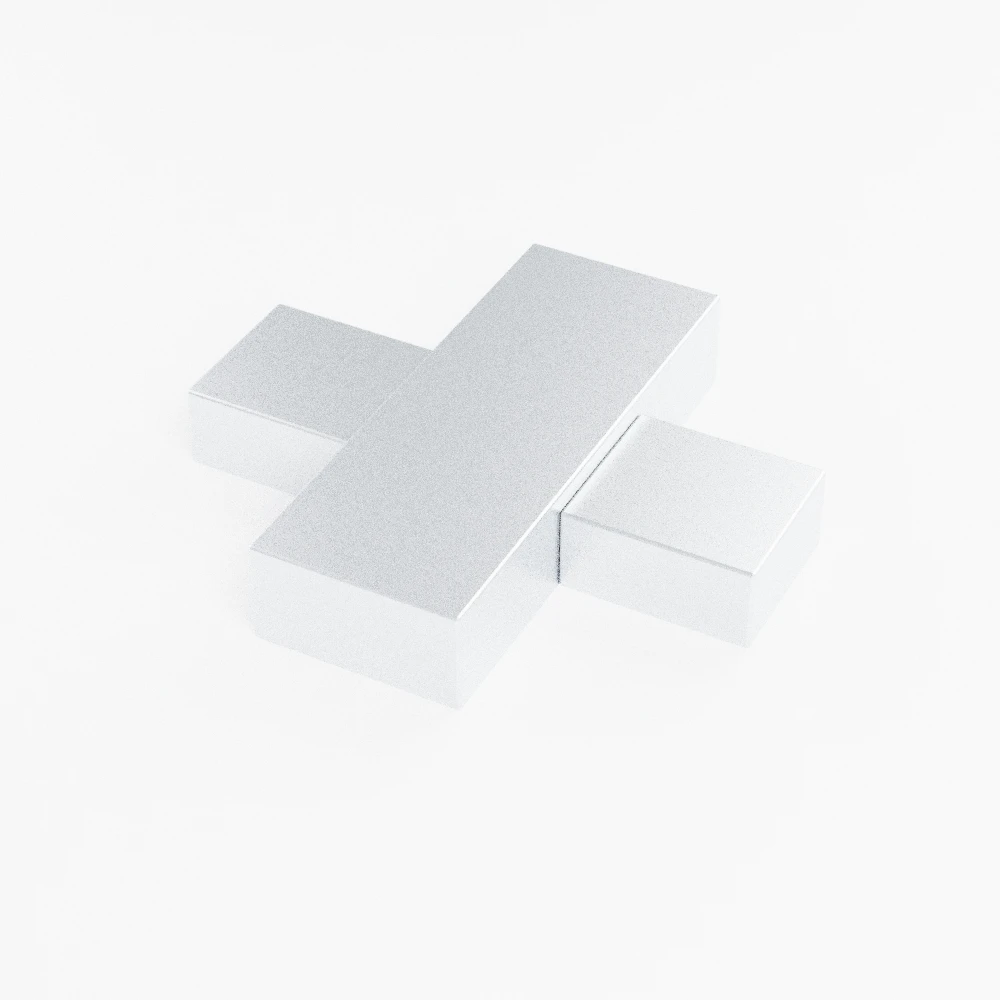
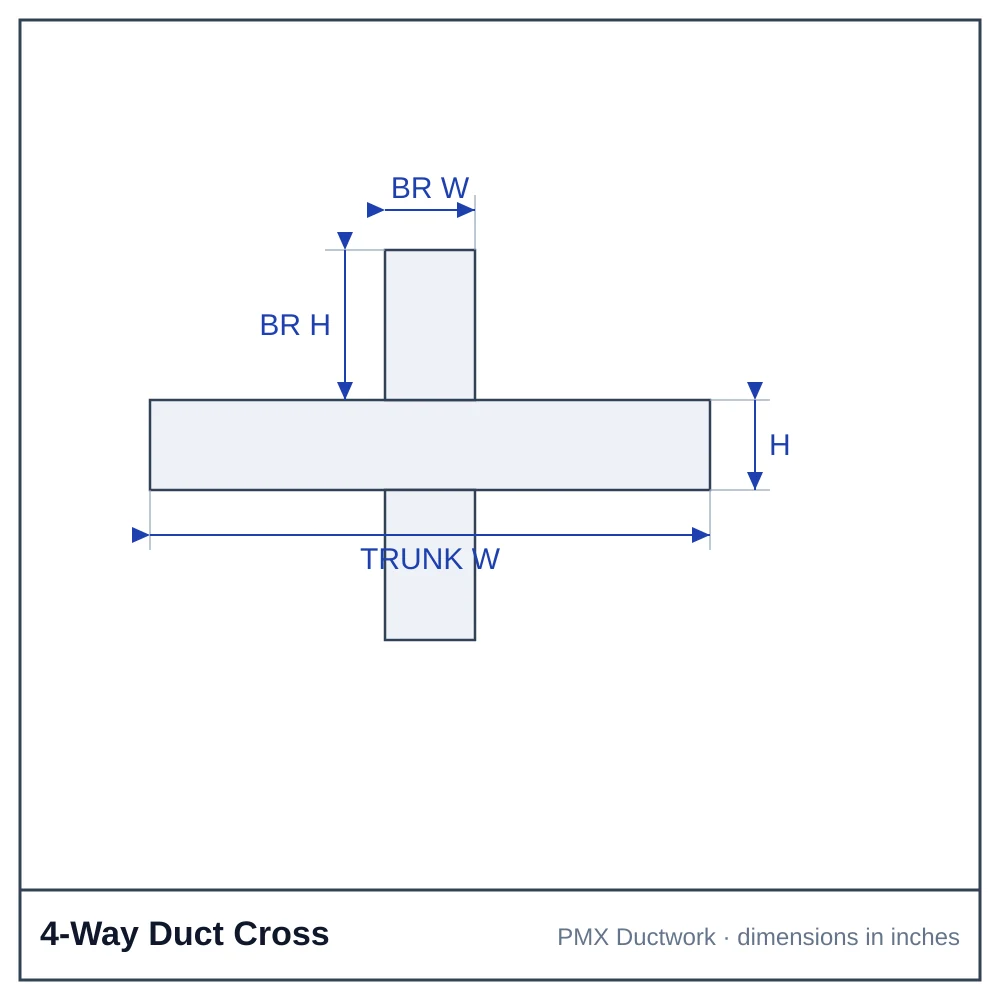
Specifications
- Trunk Width: 2" to 48"
- Trunk Depth: 2" to 48"
- Trunk Length: 6" to 60"
- Branch Width: 2" to 36"
- Branch Depth: 2" to 36"
- Branch Length: 4" to 36"
- Materials: Galvanized Steel, Aluminum, Stainless Steel
- Gauges: 26, 24, 22, 20
- Connections: Raw, Slip, Drive, TDC, Flanged
Ships in 1 business day. Every fitting is cut, formed and inspected in our Pittsburgh shop and leaves the next business day — not the one to three weeks most custom shops quote.
Popular Duct Cross Sizes & Prices
Slip-and-drive on all four openings, both branches the same size, gauge set by the trunk width. Every row is its own orderable page; the full list of 375 sizes adds aluminum and stainless for each.
| Trunk | Each branch | Material | Gauge | Price | Order |
|---|---|---|---|---|---|
| 8" x 8" | 6" x 6" | Galvanized | 24 ga | $141.75 | Order this size |
| 10" x 8" | 8" x 6" | Galvanized | 24 ga | $150.49 | Order this size |
| 10" x 10" | 8" x 8" | Galvanized | 24 ga | $159.22 | Order this size |
| 12" x 8" | 8" x 8" | Galvanized | 24 ga | $159.22 | Order this size |
| 12" x 10" | 8" x 8" | Galvanized | 24 ga | $163.59 | Order this size |
| 12" x 10" | 10" x 8" | Galvanized | 24 ga | $167.96 | Order this size |
| 12" x 12" | 10" x 10" | Galvanized | 24 ga | $176.70 | Order this size |
| 14" x 10" | 10" x 8" | Galvanized | 24 ga | $172.33 | Order this size |
| 14" x 12" | 12" x 10" | Galvanized | 24 ga | $185.43 | Order this size |
| 16" x 10" | 12" x 8" | Galvanized | 24 ga | $181.06 | Order this size |
| 16" x 12" | 12" x 10" | Galvanized | 22 ga | $197.65 | Order this size |
| 16" x 16" | 12" x 12" | Galvanized | 22 ga | $214.82 | Order this size |
| 18" x 12" | 12" x 10" | Galvanized | 22 ga | $203.38 | Order this size |
| 18" x 12" | 14" x 12" | Galvanized | 22 ga | $214.82 | Order this size |
| 20" x 12" | 12" x 12" | Galvanized | 22 ga | $214.82 | Order this size |
| 20" x 12" | 14" x 12" | Galvanized | 22 ga | $220.54 | Order this size |
| 20" x 16" | 16" x 12" | Galvanized | 22 ga | $237.71 | Order this size |
| 24" x 12" | 12" x 12" | Galvanized | 22 ga | $226.27 | Order this size |
| 24" x 12" | 16" x 12" | Galvanized | 22 ga | $237.71 | Order this size |
| 24" x 16" | 16" x 12" | Galvanized | 22 ga | $249.15 | Order this size |
| 12" x 10" | 8" x 8" | Aluminum | 24 ga | $202.59 | Order this size |
| 12" x 10" | 8" x 8" | Stainless | 24 ga | $241.59 | Order this size |
| 16" x 12" | 12" x 10" | Aluminum | 22 ga | $248.44 | Order this size |
| 16" x 12" | 12" x 10" | Stainless | 22 ga | $299.22 | Order this size |
Custom Duct Cross Fittings: The Complete Guide
A duct cross, also called a four-way tee, a double tee, a cross tee or a four-way duct fitting, is a straight run of trunk with two branch collars leaving it in opposite directions at the same point. It is the fitting a hallway trunk needs where a bedroom is on each side, a commercial main needs where two zones split off at one column line, and an exhaust header needs where two hoods sit across an aisle from each other. It is also a fitting almost no supply house stocks, because the trunk size, the branch size and the depth all have to match the job, and the combinations run into the hundreds. Every cross on this page is cut and formed to the trunk and branch sizes you type into the designer above, priced as you type, and made to order in our Pittsburgh shop.
Below is what we tell customers on the phone: what a cross is and how it differs from two tees, where it is used, how to size the branches and the continuing trunk, which gauge and material to specify, how the four openings connect, how to keep the two branches balanced, and how to measure for it. If you already know your numbers, the designer prices them instantly and the popular-sizes table links to a page for each common size.
What a duct cross actually is
Geometrically the fitting is a rectangular trunk section with a rectangular opening cut in each of its two long sides at the same station, and a short rectangular collar fitted to each opening. The collars span the full depth of the trunk in the sizes the designer builds, so each branch is as deep as the trunk and as wide as you specify; a 16" x 10" trunk with 12" x 10" branches has two collars 12" wide running the full 10" height of the trunk wall. The trunk is a straight section, so the air that does not leave through the branches continues out the far end at the same size, and a reducer after the cross is the normal way to step the trunk down for the airflow that remains.
The four numbers that define the fitting are the trunk width and depth and the branch width and depth. All four openings are finished for slip-and-drive connection in the published sizes, so the cross joins the trunk sections on either side and the branch duct on each side the same way any rectangular joint does. TDC, plain slip, raw and flanged ends are available in the designer for every opening.
Where duct crosses are used
- Hallway trunks with rooms on both sides. The most common residential case: a trunk down the center of a house or above a corridor, with a bedroom or office on each side at the same station. One cross replaces two tees and the short section between them.
- Commercial mains at a column line. Where a main runs down the middle of a floor plate and two zones split off left and right at the same column, a cross keeps the branches symmetrical and the main straight.
- Return air headers. A return trunk collecting from two grilles across from each other, or two returns from adjacent rooms.
- Exhaust and process headers. A collection header serving hoods, booths or machines on both sides of an aisle, in stainless or heavier gauge.
- Plenum splits. A short cross on the outlet of a plenum or an air handler, sending air three ways where a tee would only send it two.
- Zoned systems. A cross at the zone split with a damper in each branch, so each zone sees the same fitting and the same pressure drop.
Cross versus two tees
Two tees back to back do the same job as a cross, and the choice is mostly about geometry. If both branches leave the trunk at the same station, a cross is one fitting instead of two, two transverse joints instead of four, and about a foot shorter, and it costs less than two tees plus the straight between them. It is also easier to balance: the two branches pull from the same point in the trunk, so they see the same static pressure, and matched rooms get matched air without a damper doing the work. If the two branches are staggered along the trunk by more than a foot or two, use two tees, because the offset is what the job needs and a cross would force you to run one branch back along the trunk. If only one branch is needed now and a second is likely later, a cross with an end cap on the unused branch is cheaper than a tee today and a cut-in later.
Sizing the branches: equal area at the trunk depth
The rule that resolves nearly every cross sizing question is to give each leg of the fitting the free area its share of the air needs, at the same friction rate as the trunk, and to keep the branch depth equal to the trunk depth so the collar spans the full side of the trunk. As a starting point, take the fraction of the incoming air that each branch carries and give that branch the same fraction of the trunk's free area:
Branch area = trunk area × (branch CFM ÷ trunk CFM), and branch width = branch area ÷ trunk depth, rounded up to the next even inch.
On a cross where each branch takes a quarter of the air and half continues down the trunk, each branch gets a quarter of the trunk area. Some reference values for that split, with the branch held to the trunk depth:
| Trunk | Trunk area | Each branch at 25% | Branch size | Continuing trunk at 50% |
|---|---|---|---|---|
| 12" x 8" | 96 sq in | 24 sq in | 4" x 8" (build 6" x 8") | 6" x 8" |
| 12" x 10" | 120 sq in | 30 sq in | 4" x 10" (build 6" x 10") | 6" x 10" |
| 16" x 10" | 160 sq in | 40 sq in | 4" x 10" (build 6" x 10") | 8" x 10" |
| 16" x 12" | 192 sq in | 48 sq in | 4" x 12" (build 6" x 12") | 8" x 12" |
| 20" x 12" | 240 sq in | 60 sq in | 6" x 12" | 10" x 12" |
| 24" x 12" | 288 sq in | 72 sq in | 6" x 12" | 12" x 12" |
| 24" x 16" | 384 sq in | 96 sq in | 6" x 16" | 12" x 16" |
Two things stand out. First, equal area at the full trunk depth gives narrow branches, and a collar narrower than about 6" is awkward to seal and to fit a damper in, so the published sizes and the designer build the branch a size wider than pure area would give; the air simply runs a little slower in the branch, which is never a problem. Second, when the branches take more than a quarter each, say 40 percent to two large rooms with only 20 percent continuing, the branches grow and the continuing trunk shrinks, and the trunk almost always wants a reducer right after the cross. The calculator at the top of the page does the arithmetic for any split, shows the size of every leg, and, if you enter the CFM, the velocity in each so you can see whether a branch or the continuing trunk is running too fast. As a rule of thumb keep residential branches under about 700 fpm and trunks under about 900; commercial low-pressure systems run higher.
Keeping the two branches balanced
A cross splits air three ways, and the two branches will only share evenly if they see the same resistance downstream. That means matching branch duct sizes, matching lengths and matching register sizes on each side, or a balancing damper in each branch collar where the rooms differ. Put the damper in the collar, close to the trunk, where it is reachable and where its noise is upstream of the register. If one branch is much longer than the other, size the longer one a step larger rather than choking the shorter one, which saves fan energy and noise. A cross where both branches are the same size and both rooms are similar will balance itself; a cross serving a small bedroom on one side and a great room on the other will not, and that is a case for two branches of different sizes, which we build as a custom piece, or for a cross with a damper in the smaller branch.
Gauge
Sheet metal gauge for a cross is set by the trunk width, because the trunk wall with the branch opening cut in it is the least stiff part of the fitting. The published size pages on this site default to 24 gauge for trunks up to 16" wide and 22 gauge for trunks from 18" to 30" wide, with the branch collars in the same gauge as the trunk. That is one gauge heavier than a straight section of the same width, which is deliberate: a cross has two openings in its walls and carries four joints. Step up one gauge for medium-pressure systems, exposed duct that may be leaned on, exhaust that runs warm, or a cross that carries dampers in both collars. Every size page and the designer let you change the gauge, and the price updates on the spot.
Galvanized, aluminum or stainless
Galvanized steel is the standard for heating and cooling duct and is what most crosses are made of. It is the least expensive, it takes mastic and foil tape well, and it matches the rest of the system. Aluminum weighs about a third as much for the same gauge number, does not rust, and is specified for rooftop duct, pool and spa air handlers, coastal installations, and anywhere a fitting has to be lifted into place by hand. Stainless steel is the material for commercial kitchen grease exhaust, chemical and process exhaust, washdown environments, and any fitting that will be exposed and must stay bright. Each material is priced live; the popular-sizes table above shows all three for two common sizes so you can see the difference.
How the four openings connect
All four openings of a published cross are finished with a slip-and-drive edge: the two long sides of each opening receive an S-cleat and the two short sides receive a drive cleat, exactly as on rectangular duct, so the cross joins the trunk sections on either side and the branch duct on each side the same way any rectangular joint does. Install the cross in the trunk first, cleat and seal the two trunk joints, then bring the branch duct to each collar. Seal every joint and the branch collar seams with mastic or UL 181 foil tape; a cross has more seam than any other fitting in the run and is where an unsealed system leaks most. If the job calls for TDC flanges, a raw edge for a flexible connector, or a flanged opening at equipment, choose it per opening in the designer.
How to measure the cross you need
- Trunk: measure the inside width and inside depth of the trunk duct on either side of the cross. Those are the nominal size and the numbers you enter; the slip-and-drive allowance is added in the shop. If the trunk reduces after the cross, enter the upstream size and add a reducer downstream, or note the downstream size in the order notes.
- Branches: use the calculator above, or your Manual D or equal-friction design, for the branch width. Keep the branch depth equal to the trunk depth unless the branch duct is shallower; if it is, enter the branch duct's actual depth.
- Station: a cross puts both branches at the same point along the trunk. If they need to be offset, that is two tees.
- Connections: match what is on the duct you are joining at each opening. Slip-and-drive to slip-and-drive, TDC to TDC.
Why field-made crosses go wrong
Every installer has cut two holes in the sides of a trunk section, bent some tabs, and screwed a pair of collars into them. It moves air. It also leaks at every tab, the collars are rarely square to the trunk so the branch duct comes off at an angle, the two openings are rarely the same size so the two rooms never balance, and the cut edges of the trunk wall drum when the fan starts. A shop-made cross has none of those problems: the collars are square and concentric with the openings by construction, both branches are the same size, the seams are locked and sealed, and the only field joints are the four at the ends. On a supply trunk the difference is measurable in static pressure and audible at the register. It is also faster: a shop cross drops into the trunk in the time it takes to cleat four joints, where a field-cut pair of collars is an hour of layout, cutting and taping on a ladder, and the result still has to be sealed.
Cross versus a tee, a wye, or a plenum
The names get used loosely, so here is how we use them. A tee has one branch collar off one side of the trunk. A cross has two, opposed, at the same station. A wye splits the trunk into two 45 degree legs with no straight-through run, so all the air leaves through the two branches; it is the fitting for a trunk that ends by splitting, where a cross is the fitting for a trunk that continues. A plenum is a box with collars, meant to sit on equipment. If your trunk splits into two and stops, that is a wye; if it keeps going with a branch each side, that is the fitting on this page.
Ordering and price
Set the trunk and branch dimensions in the designer, choose material, gauge and connections, and the price shown is the price you pay; there is no quote step for standard configurations. Each cross is made to order in our Pittsburgh shop from full sheets, so an unusual size costs the same as a common one of the same amount of metal, and quantity does not change the unit price the way it does for stock fittings. Add the cross to the cart with the rest of the job, or order any of the 375 published sizes from its own page. For two branches of different sizes, a trunk outlet smaller than the inlet, dampers in the collars, or a takeoff from a drawing, call 412.725.2744 or email sales@pmxductwork.com with the dimensions.
Read more
- Duct cross fittings: four-way distribution design: the cross-versus-two-tees decision and the pressure balance across four outlets in more depth.
- Wye versus tee fittings: when a split should be a wye, a tee or a cross.
- Duct balancing guide and duct pressure drop calculation: keeping the two branches even.
- Every published duct cross size with its price.
Frequently Asked Questions
What is a duct cross fitting?
A four-way fitting: a straight run of trunk duct with two branch collars leaving it in opposite directions at the same point. Air enters one end of the trunk and leaves through the two branches and the far end of the trunk. It replaces two back-to-back tees where two branches have to come off a trunk at the same spot, such as a hallway trunk feeding rooms on both sides.
How do I size the branches on a cross?
Size each branch for the airflow it carries, at the same friction rate as the trunk, and keep the branch depth equal to the trunk depth so the collar spans the full side of the trunk. As a starting point, give each branch its share of the trunk free area: on a cross that sends a quarter of the air each way and half straight through, each branch gets a quarter of the trunk area and the continuing trunk keeps half. The calculator on this page does this and loads the result into the designer.
Do both branches of a cross have to be the same size?
On the fitting built by the designer, yes: both branch collars are the same width and depth, which suits the great majority of installations where the cross serves matching rooms or zones. If your two branches must differ, call 412.725.2744 or email sales@pmxductwork.com with the trunk size and each branch size and we will build it as a custom piece.
Cross or two tees?
A cross where both branches leave at the same point, which is nearly always the case when a trunk runs down a hallway with rooms on both sides. It is one fitting, one pair of joints, shorter and cheaper than two tees plus the straight section between them, and the two branches pull air symmetrically so they balance more easily. Use two tees when the branches are staggered along the trunk by more than a foot or two.
Should the trunk reduce after a cross?
Usually yes. A cross that sends half the air out its branches leaves only half in the trunk, and if the trunk keeps its size the velocity halves and the far end of the system sees too much pressure. Size the continuing trunk for the remaining airflow and put a reducer after the cross, or specify the trunk outlet smaller than the inlet in the order notes. The calculator shows the velocity in the continuing trunk so you can see whether it needs to step down.
What gauge should a duct cross be?
Gauge follows the trunk width. The published size pages on this site default to 24 gauge for trunks up to 16" wide and 22 gauge for 18" to 30" trunks; the branch collars are the same gauge as the trunk. A cross has more open wall than a straight section, so it defaults one gauge heavier than straight duct of the same width. Go heavier again for medium-pressure systems or exposed duct.
Galvanized, aluminum or stainless: which material?
Galvanized steel for ordinary heating and cooling duct. Aluminum where weight matters or the fitting lives in a corrosive but non-food environment such as a pool room or coastal air handler. Stainless steel for kitchen grease exhaust, laboratory and process exhaust, washdown areas and anywhere the fitting will be visible and must stay bright. All three are priced live in the designer.
Can I get a size that is not in your published list?
Yes. The 375 published sizes are the common ones. The designer accepts any trunk width and depth and any branch width and depth in quarter-inch steps, prices it instantly, and lets you add it to the cart. Every cross is made to order, so an odd size costs the same as a common one of the same amount of metal.